
What Are Low Code and No Code Platforms and How It Accelerates Digital Transformation
A digital transformation is a necessity for many businesses. Developing and publishing apps quickly and efficiently, while automating business processes and reacting to changes in customer requirements and expectations, is no longer an option. Methodical styles of software development will achieve this goal, but will require prohibitive costs, long schedules, and an extensive team of highly skilled and focused software engineers. This is the opportunity for the use of low code and no code platforms.
A no code or low code platform simplifies the software development lifecycle by including drag and drop features, as well as automation tools, reusable components, and design templates. Using the platform and tools, software developers and end users can compose an app at a fraction of the effort and time of a traditional software development project because coding requirements are drastically reduced. While a no code or low code project does not replace formal software development, they allow for faster innovation.
Businesses that are serious about digital transformation are investing in and implementing Low Code Development platforms. These systems facilitate shorter development cycles, improved interaction between the business and IT, and the elimination of redundant computing and development tasks. Gartner forecasts that by 2028, a majority of enterprise applications will be built with low-code systems and tools, which will be an indication of the extensive use of this development approach.
Strong opinion: Low code platforms empower and engage the developer community. Instead of spending time performing menial tasks, development teams will focus on their core competencies - solving business problems.
Rapid Prototyping and Faster Product Development
One advantageous aspect of Rapid Prototyping is that ideas can be assessed quickly instead of spending many months on Large Scale Development (LSD) which can be very resource intensive. Rapid Prototyping allows product teams to quickly build, test, and iterate prototypes to gather feedback from end users and decide if features are worth the investment from the engineering teams.
Instead of waiting through very long cycles of design and development, businesses can build proofs of concepts in the span of days and weeks. Rapid Prototyping relies on many different tools that can build a rapid workflow, rely on a set of UI components, and use API connections to rapidly deploy the concepts in the cloud.
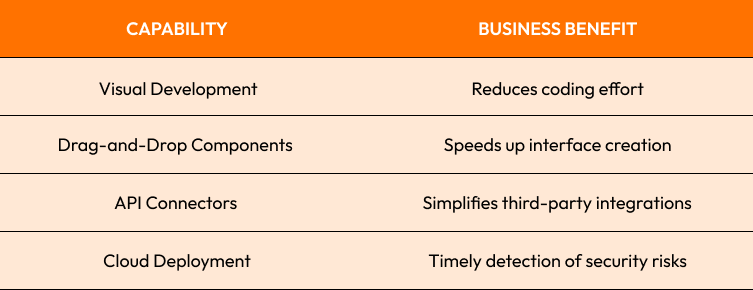
Microsoft Power Apps is a great example of a rapid application development (RAD) application. Different businesses use it to create their own internal tracking applications, approval applications, and even HR applications with no custom coding.
According to recent Forrester research, businesses that adopt low-code platforms achieve faster development and reduced time-to-market at least 50% more often than those that use traditional development methods.
In the most competitive markets, faster delivery even of a minimally viable product is more valuable than waiting for a fully-featured, technically perfect product.

Business Process Automation Using Low-Code Platforms
Employees in the modern corporation spend too long to perform too many of the same tedious and manual tasks. These tasks can be consistently automated. Business Process automation and intelligent automation can help businesses eliminate these repetitive tasks.
Low code and no code apps typically contain workflow engines, event triggers, robotic process automation (RPA), API integration, notifications, and approval workflows. These features help businesses automate their processes without developing complex enterprise software solutions.
An example of this in action is how an HR department may automate their onboarding process by creating a workflow that integrates recruitment software, a document management system, a payroll tool, and email notifications. After a candidate receives an offer and clicks an email to accept, every other process after this step will run by itself.
Automated workflows can be used by manufacturing companies to automatically track inventory, create purchase orders, and update production data in multiple systems.
Other technical capabilities found in most automation platforms include:
- Workflow orchestration
- API Integration
- Event-driven automation
- Database connectivity
- Cloud Synchronization
- Role-based permissions
According to McKinsey, of all of the work activities available today, 60% have the potential to become partially automated. This statistic shows that some automation is possible without the need to remove the employee from the task.
Strong Opinion: Organizations that keep relying on manual workflows will find it increasingly difficult to compete with businesses that have implemented intelligent automation.
Low Code vs No Code
The primary cause of confusion in low code vs no code is that they simplify application development, but they serve different audiences.
The main use of no code platforms is to enable users with no programming experience to build applications visually. In comparison, low code platforms offer the same benefits to users but retain the option for custom coding, which means professional, fully fledged software development can be carried out.
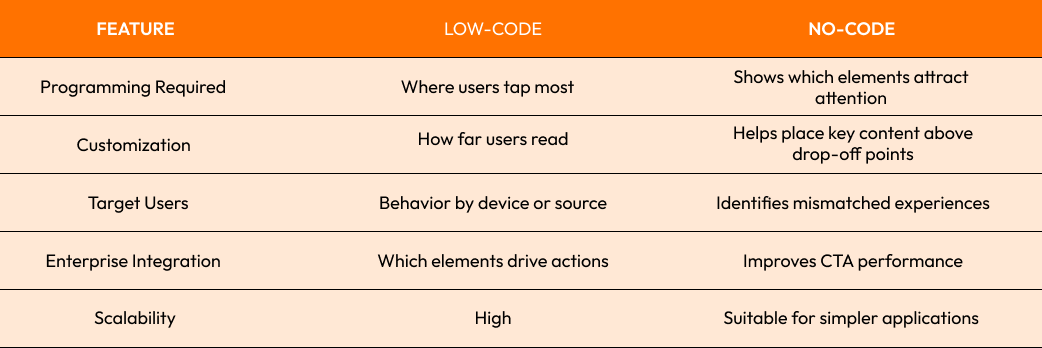
An important consideration while assessing low code vs no code platforms is that no-code might work well for a startup building their internal CRM to manage a handful of client relations. However, as the startup grows and their CRM needs to keep up with integration and scale, the startup might be better off switching to a low-code platform.
With low code and no code platforms, the general rule of thumb is to keep the future needs of the business in mind. The wrong platform for the needs of the business will almost always prove to be more costly than sticking to the right platform
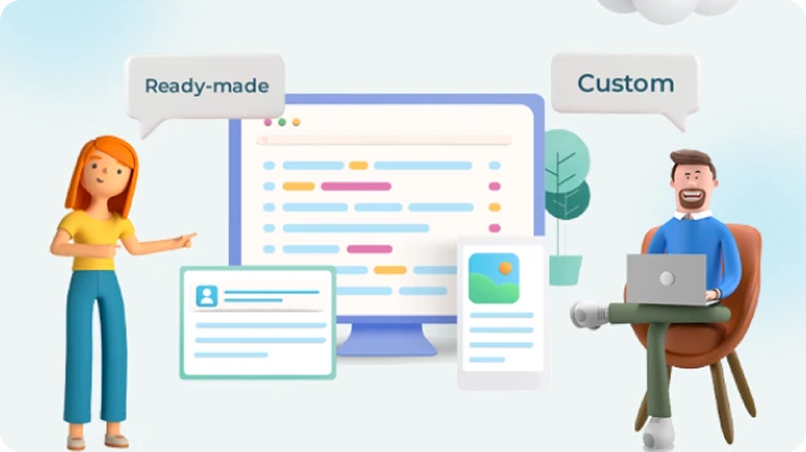
Platform Limitations and When Custom Development Is the Better Choice
For complex projects, no-code and low-code platforms will often be inadequate. Projects that require significant business logic, advanced integrations, regulatory compliance, and increased high-performance computing will be beyond the limits of these visual development tools.
Industries such as banking, healthcare, fintech, and large-scale eCommerce will require advanced custom systems, sophisticated integrations of secure advanced authentication and APIs. For these systems, trade-offs between performance and advanced custom design will be necessary.
For large enterprises, advanced no-code and low-code systems will become inflexible and costly to maintain and offer diminishing returns.
A global banking institution, for example, might no-code automate their internal systems for manual approvals while custom building their transactional systems with full custom systems.
The most successful digital transformation initiatives combine both approaches. Teams use low-code for internal productivity systems and retain custom engineering for critical business systems. Treating both systems as complimentary systems rather than competitors is ideal.
I have a strong opinion about the low-code movement: Low-code should accentuate and not diminish the role of professional software development. The companies that appreciate the role of both professional development and low-code solutions show sustained advantage in the marketplace.
Final Thoughts
The increase in the use of low-code and no-code solutions is part of a greater trend towards the use of more sophisticated digital transformation frameworks and the more efficient and effective delivery of enterprise software. Rapid Prototyping, Business Process Automation, and the differentiation of low-code and no-code solutions are just a few of the ways these disruptive development solutions are enabling enterprises to rapidly deliver line-of-business applications.
Success is driven by the appropriate use of the solution to the appropriate problem. While much of business visual development showcases rapid results, particular demand remains for large scale, custom, built systems leveraging professional, custom development for greater flexibility, security, and integrity.
Businesses should assess the level of complexity, the integration needs, the expected performance, and the growth of the solution over time before settling on a development solution. The architectural integrity of the solution is of greater concern than rapid delivery.

Are you Willing to Move Forward on Your Digital Transformation?
Crescentic Digital will provide the rapid line-of-business applications, business process automation, and fully integrated enterprise solutions that support your business objectives.
Our professional development team will help you to choose the most appropriate technology, create rapid and scalable systems, and facilitate the automation of your business, all without compromising flexibility or growth.
Visit our Contact Page for the opportunity to engage with us on your transformational ideas. We will provide the tools to realize your vision.
Start Your Expert Consultation
Please write your name and contact information below. We will respond as soon as possible.