
Web Performance Engineering: Beyond Core Web Vitals Optimization
Web Performance is a key foundation that modern digital experiences rely on. Web Applications should load instantaneously, respond seamlessly, and act in the same way on different devices. Most teams are obsessed with Core Web Vitals, but real performance engineering covers a lot more ground than just key metrics.
In the present days, you can no longer get away from just optimising only for Web Vitals. The time taken in scoring should not be considered as a parameter of fast experience. Actual performance relies on the inner workings of systems, JavaScript execution, resource delivery over networks, main thread activity, and effective asset loading.
This is why web performance optimization goes beyond a checklist, it becomes an area of study.
Strong opinion:
Most websites are technically optimized on paper but they still feel slow in real usage due to deeper system-level performance issues.
Let us dissect what really matters beyond the standard metrics.
Beyond Core Web Vitals: Advanced Performance Metrics That Matter
The Web Vitals are great as a base measure, but they only capture part of the user experience. Again, I know LCP FID & CLS are very important web vitals metrics but they do not give us the complete picture of overall website performance.
Advanced performance engineering focuses on:
- Time to Interactive (TTI)
- Total Blocking Time (TBT)
- First Input Delay (real-world variability)
- CPU utilization patterns
- Frame rendering consistency
These metrics touch upon how users perceive Web Performance in Sri Lanka contextually.
A page can, for example, have good LCP but still be perceived as slow because heavy Javascript execution is blocking the main thread.
Here’s a quick comparison:
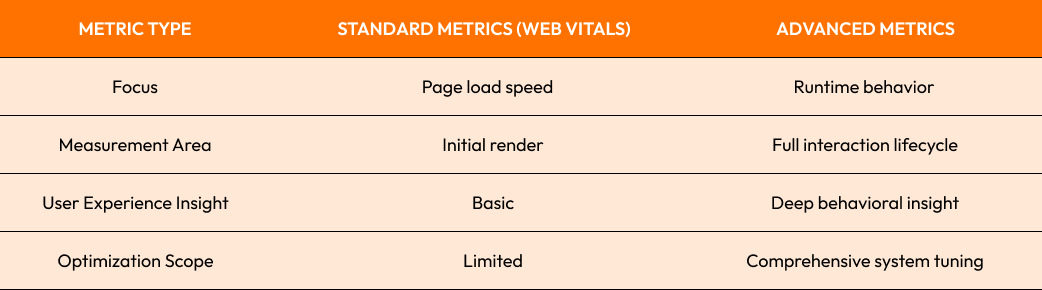
Analysis done by Google suggests that increasing interaction responsiveness has a greater impact on user retention than lowering loading time.
Strong opinion:
Optimizing Web Vitals marks the idea of checking your car speed and ignoring engine health.

JavaScript Execution Optimization and Main Thread Performance
JavaScript blocking the main thread is one of the largest hidden performance problems in modern Web Applications.
The main thread handles:
- UI rendering
- Event handling
- User interactions
Finally, everything is slow when JavaScript execution gets heavy.
Enter Thread Performance.
Common issues include:
- Long-running scripts
- Poorly optimized loops
- Excessive third-party libraries
- Blocking synchronous tasks
To improve performance, developers use:
- Code splitting
- Web workers
- Debouncing and throttling
- Tree shaking
- Async rendering patterns
In this respect, Pinterest achieved much better performance by shortening JavaScript execution time and splitting large bundles into smaller parts. This also improved the user engagement metrics and reduced interaction delays.
The other notable technique is Offloading statistics heavy work to the Web Workers, in which case the main thread remains responsive.
Strong opinion:
And if your UI hangs, it doesn't matter how fast you load; no one will want to go to a page with unresponsive controls.
Not about the fast visible appearance but smooth interaction.
Network Performance Optimization: Caching, Compression, and CDN Strategies
If the Network Performance is poor, even a perfect frontend code fails.
Network performance dictates the speed at which assets in transit get from server to user. This includes:
- HTML
- CSS
- JavaScript
- Images
- API responses
Key optimization techniques include:
- Caching Strategies
It eliminates repetitive downloading and helps speed up page loads for repeat visitors, using browser caching. - Caching Strategies
It eliminates repetitive downloading and helps speed up page loads for repeat visitors, using browser caching. - Compression
Gzip and Brotli compress the size of files for sending over wire. - CDN Usage
By distributing assets globally, Content Delivery Networks reduce latency. - HTTP/2 and HTTP/3
Multiplexing and connection overhead efforts are improved in modern protocols.
Here’s a simple comparison:
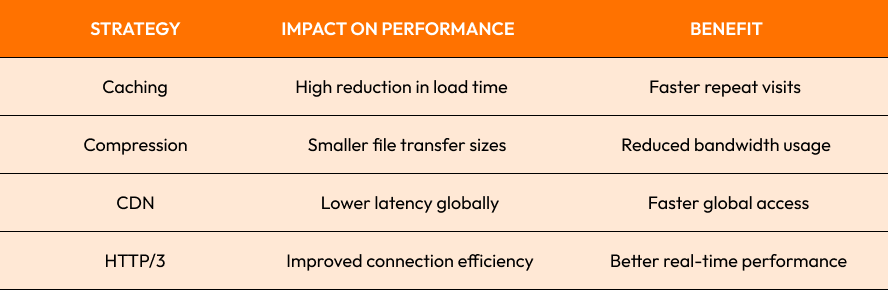
Akamai, for example, showed that an e-commerce platform can increase their conversion rates by measuring how much latency they reduce (7% using by making each 100ms of improved performance).
Strong opinion:
Poor backend performance can never be compensated with frontend optimization, network behavior matters just as much

Lazy Loading, Resource Prioritization, and Asset Optimization
Streamlined loading techniques are the backbone of today's Web Performance engineering!
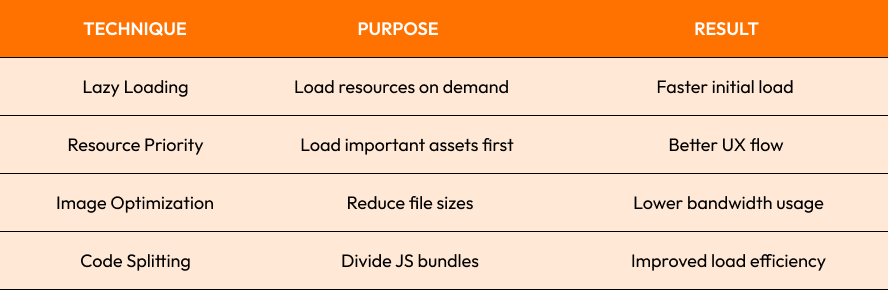
One of the most powerful techniques is Lazy Loading, which enables you to load resources on demand rather than loading all up front.
This applies to:
- Images
- Videos
- Components
- API data
The purpose of lazy loading is to decrease a page's load time and help users perceive the app as being faster.
Resource prioritisation is also something which should practised:
- Critical resources load first
- Non-critical resources load later
This makes sure that users reach usable content as quickly as possible.
Asset optimization includes:
- Image compression (WebP, AVIF)
- Minified CSS and JavaScript
- Font optimization
- Removing unused code
Now, consider a great case in point: YouTube which utilizes complex lazy loading and dynamic streaming to support buffered playback even on a slow network.
Here’s a simple breakdown:
Strong opinion:
Preloading everything is not efficient; it is a waste in simple clothing.
Best Practices for Building High-Performance Scalable Web Applications
Fast systems are not one trick; they require constant engineering discipline.
Here are the major ingredients in an effective Web Performance strategy:
- Monitoring real-user metrics
- Reducing JavaScript payload size
- Optimizing rendering pipelines
- Improving Network Performance
- Managing Thread Performance efficiently
- Using Lazy Loading strategically
Deloitte has actually found that 0.1 seconds improvement in site speed can increase the conversion rates to a big extent in competitive industries which is one of the important ways of understanding and optimizing user engagement with web pages.
Also, companies like Amazon keep investing in performance engineering as even a millisecond matters for revenue at scale.
Performance should not be perceived as an end-of-the-road step. It must be incorporated into development from day 1.
Strong opinion:
Performance is not a feature; it is the groundwork of user experience.
Final Thoughts
Web Vitals is only a fraction of what modern performance engineering has to offer. In addition to controlled metrics, real optimization means knowing how systems will perform in the real world.
Everything you do from Thread Performance to Network Performance, Lazy Loading to execution optimization, each layer helps create the end experience users feel.
Key Challenges:
- Overloaded JavaScript execution
- Poor network configuration
- Unoptimized assets
- Ignored runtime performance
- Lack of real-user monitoring
Best Practices:
- Optimize main thread execution
- Reduce JavaScript bundle size
- Use CDN and caching aggressively
- Implement lazy loading correctly
- Continuously monitor real-world performance
Strong opinion:
Fast sites are not built; fast sites are engineered.

Ready to Improve Your Web Performance?
Crescentic Digital is using the power of Web Performance frameworks to make businesses flexible through improving Web Performance at every layer of their web stack from frontend rendering, Network delivery and System Architecture.
Head on over to our Contact Page and let us use best practice web performance optimisation techniques to build high-performing systems.
Start Your Expert Consultation
Please write your name and contact information below. We will respond as soon as possible.