
Vector Databases and Embeddings: Powering Modern AI Search Systems
Search has changed. It can identify meaning now rather than search for exact keywords. Today, when users type a question, they expect systems to “get it,” not simply look for similar words. This change is driven by vector databases and embeddings.
So what are they and why should you care?
At an elementary layer databases record information that encapsulated the meaning, not merely the structure. Instead of rows and columns, they operate on numerical representations of data - vectors that capture relationships and context. These vectors are derived from embeddings, which convert text, images or other data into numbers that can be compared by machines.
This is what makes modern AI systems capable of semantic search, content recommendation and complex tasks like chatbot operation. Without vector databases, many of today’s AI-powered experiences wouldn’t work, in fact, they're the pillar behind today's AI systems.
Here’s the strong truth:
If your search system is still stuck onto traditional databases, you’re not just late; you are invisible in an era where everything runs on meaning.
Understanding Embeddings: Turning Data into Numerical Vectors
First, you need to understand that Embeddings are the numerical representations of data that carry meaning and relationships. Rather than treating words or items as independent entries, embedding puts them in a multi-dimensional space where similar items will be close to one another.
For example:
- “Laptop” and “computer” would have close vectors Microsoft’s HoloLens 2 headset in use on March 23, 2020.
- “Laptop” and “banana” would end up in distant ends
This enables systems to recognize context rather than exact matches.
In short, deep learning models trained on gigantic datasets generate embeddings. These models learn patterns of language, images or behavior and encode them into dense vectors.
Why does this matter?
Because it enables semantic search. Instead of asking: “Does the keyword appear in this document?”
The system asks: “Does this document have any meaning relevance to the query?”
A practical example: A user looks for “affordable smartphones.” If the system sees the phrase “budget mobile devices” in a product description, embedding helps it relate that to budget cell phones.
And this is the bedrock of modern search.

The Key Differences Between Traditional Databases and Vector Databases
To understand the true value of it, we can contrast them with traditional systems.
Traditional databases are designed for structured data. They shine on finding and returning exact matches. But they have difficulty with similarity and context.
Vector databases, by contrast, are specialized for similarity search. They are trained to locate data points that are “close” in meaning.
Here’s a clear breakdown of the key differences that you need to know:
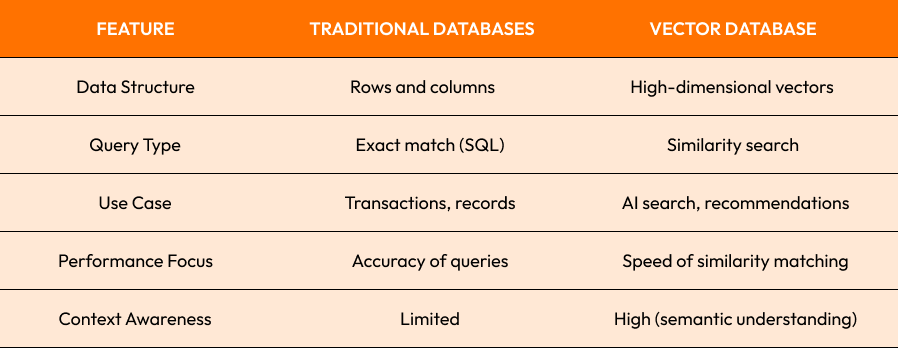
In e-commerce, a case study illustrates this distinction. Keyword-based search on a platform suffered from low result relevance. By using a vector-based system, search relevance improved by more than 40%, and overall engagement increased drastically.
Strong opinion: Traditional databases aren’t “bad”; they’re just not designed for the modern AI problems.
The most intelligent systems today use both methods.
Retrieval-Augmented Generation (RAG): Combining Search with AI Models
Among its most potent use cases is Retrieval-Augmented Generation (RAG).
Retrieval-Augmented Generation combines two things:
- Retrieval (finding relevant data)
- Generation(Generating response fragments using ML Models)
This means that, rather than only relying on all pre-trained knowledge, AI models can fetch up-to-date and relevant information from the vector database to produce better answers.
Here’s how it works:
- A user asks a question
- It is converted into an embedding by the system
- To do so, the vector database fetches the most relevant data
- That data is used by the AI model to formulate a response
This approach addresses a significant limitation of AI, its outdated or incomplete knowledge.
Customer support systems are the best case in point of this. This means that, instead of a generic conversation, RAG-powered companies can retrieve answers straight from their internal documents or knowledge bases or FAQs. This allows for more accurate answers with fewer hallucinations.
It is reported that RAG-based systems increase response relevance by 30-50% when compared to standalone models.
This is not merely an enhancement; it’s a change in how AI systems work.

Real-World Use Cases: Chatbots, Recommendations, and Search Engines
Vector database’s real value comes in practice. Let’s take a look at where they’re having the biggest impact.
- 1. Chatbots
Chatbots found in modern applications, along with a vector search for semantic matching of relevant information to user queries. It results in much more fluid and realistic conversations. - 2. Recommendations
Example Platforms - Streaming services and online stores use vector similarity extensively for recommendations. This means systems derive behavior and preference comparison to suggest content that appears personalized. - 3. Search Engines
Search is no longer keyword-driven. Semantic search boosts relevance and user satisfaction. - 4. Fraud Detection & Security
They identify abnormal behavior and highlight potential threats by analyzing patterns and similarities. - 5. Content Discovery
For instance, media platforms utilize vector search to recommend the articles, videos, and music in accordance with user interest.
One of the most popular examples: The recommendation engine behind Spotify is powered by vector-based systems that enable users to discover new songs. It's this fact that has been crucial in retaining and engaging users.
The takeaway? This is not experimental; these systems are already establishing how big platforms work.
Challenges, Scalability, and Best Practices in Vector Search Systems
Vector databases provide powerful capabilities, but they are not without challenges.
- 1. Scalability
Millions or billions of vectors need indexing and storage. It also relies on techniques such as Approximate Nearest Neighbor (ANN) search to preserve speed. - 2. Data Quality
Though, bad embedding = bad result. If the input data is poor, output from the system will be unreliable. - 3. Cost and Infrastructure
Vector database and retriever systems can be resource-hungry, particularly when there is a need for real-time queries. - 4. Integration Complexity
Integrating vector databases with existing systems is a minefield, requiring careful planning and solid APIs.
Now, let’s get into the best practices details:
- A user asks a question
- Employ domain-specific high-quality embedding models
- Empower your results by mixing vector search with traditional filtering
- Optimize indexing for faster retrieval
- Keep updating the embeddings on new incoming data
- Track performance and iterate according to how users behave
Strong opinion:
Vector search systems fail less because of the technology and more because of bad implementation.
According to Pinecone, companies that deploy vector databases properly optimized can achieve up to 60% faster search than traditional methods.

Why This Is Important Now: Final Thoughts
These include everything from embeddings to Retrieval-Augmented Generation, allowing for contextually aware systems that provide relevant output and enhance user experiences.
But here’s the reality:
Most of these businesses still use front-end queries. They are keyword driven when users think in terms of meaning.
When looking to create more intelligent systems, be it search or AI powered applications, you are forced to look beyond the way your data is stored and retrieved.
Geared Up for Building Smarter AI Systems?
If you are serious about improving search, recommendations or AI-driven experiences it’s time to think beyond traditional approaches.
When it comes to developing and scaffolding new AI systems from embedding to complete integrated vector search architectures, Crescentic Digital assists businesses in building modern AI infrastructure.
Do you want to create systems that actually know your users?
Go to our Contact Page and let’s build AI solutions that truly matter.
Start Your Expert Consultation
Please write your name and contact information below. We will respond as soon as possible.