
Mobile First Development Improves global search rankings
In the past decade, the way that people use the Internet has dramatically changed. More than 50% of all web traffic is now generated by mobile devices, which makes smartphones the main gateway for online content. Google recognized this change and introduced mobile-first indices, meaning that the mobile version is considered to be the main version when ranking and indexing websites.
Mobile-First Web Development has become a strategy that is essential for companies who want to be more visible in Global Search. Websites that are optimized for mobile not only provide a better user experience, but they also help search engines to rank them higher.
Companies who continue to ignore mobile optimization struggle to rank in the search results. Businesses that take a mobile first approach often see an improvement in conversion, engagement and search performance.
Strong opinion: Today's digital environment is such that a site not optimized for mobile devices is already behind the competition.
The Mobile First Web Architecture is a Supporter of Better Search Visibility
Every successful website is built on a solid Web Architecture. The mobile-first approach encourages designers to focus on content structure, usability, and navigation from the smallest screens upward.
Websites that are first designed to be viewed on mobile devices often eliminate unnecessary complexity. When websites are designed for mobile devices first, unnecessary complexity is often eliminated.
Google's crawlers can better understand the relationships between pages because of this simpler architecture. Search engines can index and discover content more quickly with clear URLs, internal links, and responsive designs.
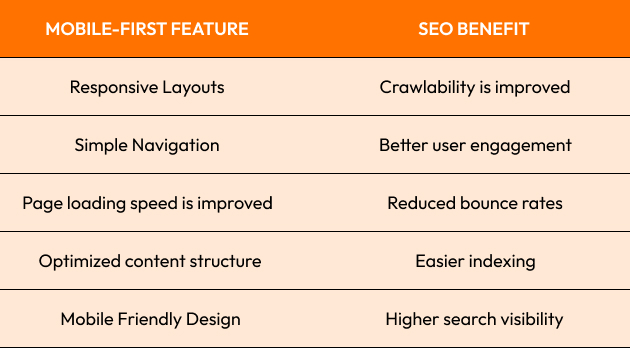
You can see this in the restructured navigation of ecommerce sites for mobile users. Crawl efficiency is often improved by a cleaner category hierarchy.
Structure is the key to search visibility. When website structure is poor, even the best content can struggle to rank.
The Impact of Mobile Optimization on Core Web Vitals
Google's web vitals are a ranking factor that is important because it measures how users experience websites.
Three primary metrics are:
- The Largest Containing Paint (LCP).
- Paint Interaction Next (INP).
- Cumulative layout shift (CLS).
The mobile-first approach to development supports the improvement of these metrics, as performance is a top priority right from the start.
Focus of developers on:
- Images optimized
- Efficient JavaScript delivery
- Responsive layouts
- Server response time is faster
- Resource prioritization
Google's research shows that websites with improved Core Web Vitals tend to have a higher level of engagement and fewer abandonment rates.
One well-known example involved a retail platform which improved the speed of mobile pages by reducing images sizes and removing unnecessary scripts. This resulted in faster loading speeds and an increase of user interaction.
It is my opinion that performance has become more than a technical measure. It has a direct impact on business growth, rankings in search engines, and customer satisfaction.
Better experiences are often a result of faster websites, which in turn leads to better SEO.

How Mobile-First Development Strengthens Local Search Performance
Local Search Visibility is as important to many companies as their global ranking.
Mobile devices are often used by users to search for local products, services or locations. These moments demand a fast, seamless and responsive experience. Mobile-first sites provide that.
Google's Local Ranking System considers several factors including:
- Mobile usability
- Location Relevance
- Website Speed
- User engagement
- Accessibility of content
A restaurant's mobile-optimized site, for example, allows customers to access information such as menus, directions and contact details. The convenience of this feature increases user engagement, and helps to boost local visibility.
Mobile users tend to be more likely than other mobile users to act immediately, such as making an immediate purchase, booking an appointment or physically visiting a location.
Strong opinion: Companies that invest in local SEO but ignore mobile optimization miss out on opportunities.
Local search results can be converted into actual customers by using mobile-first experiences.
Building Customer Trust Through Seamless Mobile Experiences
Customer Trust is essential to digital success. Within seconds, users form an opinion about a company's website. The negative impact of slow loading speeds, difficult navigation, and broken layouts is difficult to reverse.
The goal of mobile-first development is to create experiences that are consistent across devices.
The following elements can help to build trust:
- Pages that load quickly
- Clear Navigation
- Brand consistency
- Enjoy a safe browsing experience
- Accessible content
Stanford University conducted a study that found website credibility has a significant impact on purchasing decisions as well as user confidence.
Amazon, for example, has invested heavily in the mobile experience because it understands that conversions and retention are directly affected by trust.
Experiences, and not promises, build trust. Professionalism is communicated far better by a well-designed website than through marketing messages.
Users are more likely to interact with businesses if they feel comfortable navigating the website.

Optimizing Modern Web Applications for Mobile-First Indexing
Modern web applications have become more sophisticated. Applications must be able to balance performance and functionality. This includes ecommerce and SaaS platforms, customer portals, and dashboards for business.
Developers must ensure mobile versions have the same metadata and functionality as desktop devices.
The following are key technical considerations:
- Responsive rendering
- Progressive Web App (PWA) support
- Lazy loading
- Implementation of structured data
- Navigation mobile-friendly
To ensure scalability, search engine compatibility, and scalability, companies using frameworks like React, Next.js and Angular often adopt the mobile-first principle.
In a case study of several SaaS platforms, it was shown that improving mobile experience improved both user engagement and organic visibility.
Mobile-first indexing should not be viewed as a requirement for SEO. This reflects the way real users interact and access digital products.
Final Thoughts
Mobile browsing is changing the way websites are developed and designed. For businesses to achieve better Global Search rankings, they must focus on mobile experience.
Mobile-first development impacts every aspect of performance online. From improving Web Architecture to optimizing Web Vitals, strengthening Local Search and increasing Customer Trust and modern Web Applications.
The Common Challenges of Mobile First:
- Page speeds are slow
- Poor navigation structures
- Unoptimized media files
- Inconsistent mobile experiences
- Indexing problems
The Best Practices:
- First, design for mobile devices
- Continuously optimize Core Web Vitals
- Simple website structure
- Prioritize fast-loading content
- Test across multiple devices regularly
It is my opinion that mobile-first development no longer represents a competitive edge, but rather the minimal standard to achieve sustainable growth in search.

Ready to Improve Your Search Visibility?
Crescentic Digital helps businesses create high-performance mobile-first sites that increase user engagement, improve SEO performance and help support business growth.
Our team will help you design digital experiences for every platform, whether you require a responsive site, an optimized website application or a full SEO focused redesign.
Discover how mobile first development will help you achieve better search results and stronger rankings for your company. Visit our Contact Page now.
Start Your Expert Consultation
Please write your name and contact information below. We will respond as soon as possible.