Improve Website Authority With Technical SEO Strategies
Establishing powerful Website authority is not about simply publishing content and gathering backlinks anymore. Search engines are also a lot more complex now. Today, they assess a site technically, how a user will interact with it and if the structure provides for an authenticated experience.
This is where technical SEO comes more important than before.
A slow website, broken internal structure or poor mobile performance, as well as weak indexing signals can easily deteriorate rankings without the content itself being affected. Conversely, websites with solid technical foundations will often outperform competitive sites that have massive amounts of content because the user experience provided by a clear and credible front-end typically helps users convert better.
SEO never ends with keywords in today's modern world. It is a combination of infrastructure, speed, usability and crawlability.
Besides this is where Technical SEO Strategies come into play. Technical SEO lays down the structure, from page speed improvement to internal linking and international targeting, which enables search engines to understand your site that you can rely on.
Strong opinion: A ton of brands overemphasize content marketing but donít bother with technical SEO. That’s a mistake. Great content only goes so far without a strong technical foundation.
How Strong Web Architecture Improves Website Authority
A Strong Web Architecture Is One Of The Most Overlooked Ranking Factors in SEO
Fundamentally, web architecture is how pages within a site fit together in terms of structure and linking. Great architecture supports users and search engines in easily crawling content.
Think of it this way: Search engines will struggle too: If visitors can have trouble hunting down info
A well-organized set of websites makes use of clear and direct pathways from page to page by making use of:
- Logical URL structures
- Internal linking systems
- Organized category hierarchies
- XML sitemaps
- Breadcrumb navigation
It improves the efficiency of crawls and helps to disperse authority to key pages.
Here’s a simple comparison:
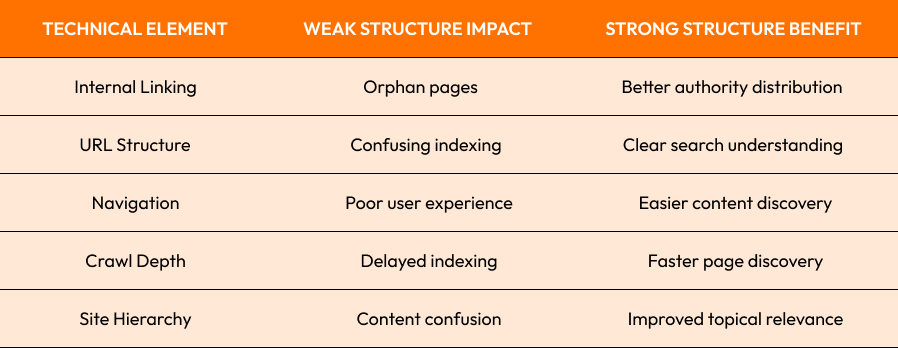
Backlinko performed a case study which showed that good internal link structure vastly improves crawl rates and indexing efficiency vs poorly structured sites.
The architecture is part of what makes large websites like Amazon succeed. The internal links and their filtering and categorization present all of these millions of pages in an easy-to-navigate manner for users and search engines alike.
Strong opinion: A messy site structure means leaking authority everyday.
You should have built a strong architecture; this is not an optional solution but a foundation.
Why Web Vitals Matter for Better Search Performance
User experience became too important to neglect, and this in turn led Google to introduce Web Vitals.
Google also now evaluates how actual users interact with a website (with respect to speed, responsiveness, and visual stability).
Core Web Vitals consists of the following three primary metrics:
- Largest Contentful Paint (LCP)
- Interaction to Next Paint (INP)
- Cumulative Layout Shift (CLS)
These are the metrics that determine whether users experience smooth navigation or frustration.
A poorly performing website doesn’t only affect the ranking but it affects conversions too.
According to Google research:
- If the page load time is from 1 second to 3 seconds, the probability of bounce increases by 32%.
- Delays are often worse for mobile users.
Hence, high-performing websites think of the way they will:
- Image optimization
- Code minification
- Lazy loading
- CDN implementation
- Server-side caching
From Vodafone, for example: They then went on to state that the complete new site with better loading experiences resulted in an 8% sales increase from improved performance data points after auditing.
Here is the truth that most of companies are turning a blind eye on: Users rarely complain about speed. They simply leave.
Strong opinion: Most times, it is not because of the content that SEO campaigns fail but more due to an irritating experience on the site.
Fast websites build trust instantly. Users bounce as soon as the site is loaded before they read a headline due to slow websites.
Building Customer Trust Through Technical SEO Optimization
A technically optimized website has a direct impact on Customer Trust, because users subconsciously base reliability on their experience.
Before to giving 5 trust signals that technical SEO plays with:
- HTTPS security
- Mobile responsiveness
- Fast loading pages
- Error-free navigation
- Safe browsing experience
- Structured data markup
A website can kill confidence immediately when it shows broken pages, popups on every second of browsing and an unstable layout.
Thirdly, technical optimization enhances cross-device consistency. If a website is working fine on desktop but breaks on mobile, that creates friction and indeed, friction kills trust.
Another important factor is structured data. Rich snippets such as reviews, FAQs, and ratings make a website look more reliable in search results.
According to Stanford, 75 percent of users make judgments about a company’s credibility based on its website design and functionality.
That’s massive.
Technical Search Engine Optimization also helps reduce the issues such as:
- Broken redirects
- Duplicate content
- Indexing errors
- Crawl anomalies
While these points may appear negligible from the inside, they create a very bad impression on outsiders.
Strong opinion: Branding is no longer the entire basis of trust. It is generated from performance and trustworthiness.
When your site is a little rocky, users think your business is too.

Optimizing for Global Search to Increase Website Reach
Translation is just one piece of the puzzle when scaling up in visibility globally. Optimise for Global Search: You are training it on which audience your content is aimed towards.
This is where many websites make a key mistake:
- Duplicate international pages
- Incorrect hreflang tags
- Poor geo-targeting
- Slow international load times
This confuses search engines and dilutes visibility.
For a wider global reach, businesses need to focus on:
- Hreflang implementation
- Region-specific URLs
- Localized metadata
- Multilingual optimization
- Global CDN usage
For example:
- example.com/uk/
- example.com/us/
- example.com/pk/
That structure helps search engines find and serve the correct content to the right users.
International SEO setup also makes you more relevant to users. Localized experiences, currencies, language variances and culturally adapted messaging drive more engagement.
An important case study of this comes from Airbnb. Global SEO structure allowed them to scale their visibility internationally, and have regions pages optimized for specific crawling in a different language.
Technical SEO also optimizes crawl paths for International indexing speed server distribution.
Strong opinion: Translation alone does not bring global exposure. It requires technical precision.
Businesses are never even found by the people who need them most, as they have not optimized for international but it is too late but growth has stalled at that point.
Final Thoughts
Website authority is built through technical integrity, user experience and consistency; not hacks.
Content is still important, but without the technical side of SEO you have no chance of scoring that performance. An optimised website with better loading speeds means trust, better indexing due to the nature of the site and visitors from all over the world which equals a much better experience for both humans & crawlers.
But here is the hard truth that a lot of businesses do not want to hear: Most websites are technically under-optimized.
They overlook slow performance, poor structures, crawl inefficiencies and mobile usability issues to publish even more content. These technical gaps gradually erode placements and rank acumen, silently.
Common Technical SEO Challenges:
- Slow loading pages
- Weak internal linking
- Poor mobile optimization
- Crawl and indexing errors
- Duplicate content issues
Best Practices:
- Build clean site architecture
- Continuously monitor Web Vitals
- Improve crawl efficiency
- Optimize for mobile-first indexing
- Strengthen security and trust signals
Want to Leverage your Domain Authority?
But if your site is not ranking, not converting, or not scaling internationally, it may not be your content; it may be your foundation.
We specialize in helping businesses amplify their technical SEO, enhance site performance, and establish sustainable authority to achieve scalable growth at Crescentic Digital.
Wanna get a more transparent site that indeed scores higher in search and actually receives genuine trust?
Check out our Contact Page and let us help you transform your website for a lasting impact!
Start Your Expert Consultation
Please write your name and contact information below. We will respond as soon as possible.