
Important Web Security Protocols To Safeguard User Information
Safeguarding user data is a necessity in the current climate. From account registrations and online purchases to sending contact forms, every single example involves the transfer of some sensitive data. Today’s cyberattacks are more advanced than ever, and to keep protecting their customers and earning their trust, businesses are required to strengthen their Web Security practices.
With just one single weakness in security, hackers can access personal, financial, and private business data. The Cost of a Data Breach Report from IBM states that the average data breach is over $4 million. This shows how expensive data breaches are for businesses of any size.
Security is more than just strong passwords and SSL certificates. Comprehensive web security also encompasses secure coding practices, constant security checks and assessments, strict access controls, and automated security. This is the reasoning behind the importance of secure web development in building dependable digital infrastructures.
Security is not an area a business should cut corners on. The cost of security being an afterthought is always more customers, more financial losses, and a more damaged reputation.
Why Defense Against Cyber Threats Begins With Input Validation
User input that is handled in an unsatisfactory way is the cause of many security incidents. One of the best methods to stop users from exploiting a web application is the Implementing Input Validation.
When a user inputs data into a form, a search bar, a login field, or an API, it is necessary for the website to match the incoming data against a known pattern. Without this, an attacker can exploit this to write harmful code using techniques like SQL Injection, Cross-Site Scripting and command injection.
For instance, a login form should not accept data in any arbitrary or unexpected form. Characters, scripts, or payloads that do not express a valid form of a username and password should not gain access to the backend.
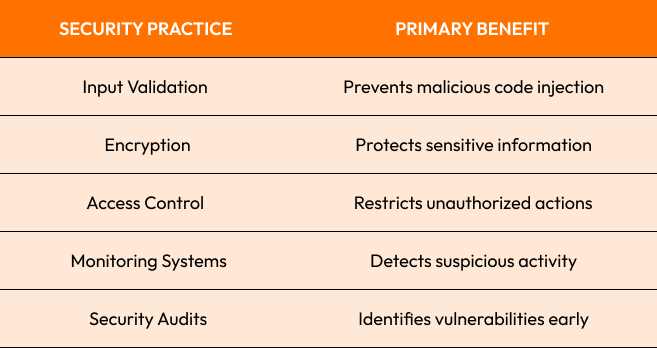
A case many are familiar with is when attackers used an unprotected web form to exploit SQL and access customer forms. Many attacks like this can be prevented with parameterized queries to the database and validation.
Lack of input validation is like leaving the door to the house open while having an expensive alarm system installed.
Validation libraries exist in many development frameworks but protection is only guaranteed when developers know how to implement them.
Best Practices for Strengthening Data Protection on Modern Websites
Data protection is not a single security mechanism. Using a single security mechanism is inviting exploitation across the redundant and interlinked security mechanisms of your web application.
One primary method is protecting sensitive data. Sending and saving sensitive data requires special care. Data protection protocols like TLS secure data sent between users and data protection in databases secure data saved in databases.
There are several methods to protect data: tokenization, secure hash algorithms, and key management systems.
These methods used by financial institutions like the protection of customer payment information and customer data using modern cryptographic standards serve as good illustrations. If attackers gained access to a data protection method, the cryptographic method would make exploitation of the information very hard.
Layered security methods are the best. Research shows that breaches are the least for those organizations that use the most security layers.
Additional high-impact methods:
- Vulnerability assessment methods that are frequent
- Sufficient backup methods
- Monitoring database activity
- Patch methods that are automated
High-impact methods are the most effective. The protection of customer data depends on trust, therefore the business owns the protection of customer data.

Managing User Access to Preventing Unauthorized Activity
One of the most important aspects of Web Security is Managing User Access, yet it is one of the least prioritized.
It is important to note that not all employees or customers need the same level of permission. Role-Based Access Control assists organizations to grant permissions that correlate to the provided resources to users.
Some examples include:
- Customers view their respective account
- Customer service representatives access tools that assist them in the service of customers
- Administrators have control over the settings of the platform
- Developers access environments that are for Development.
This is commonly known as the Principle of Least Privilege.
One major case study focused on a large company that experienced internal data leaks due to allowing too many cross-departmental permissions. After the company instituted strict access policies, it was able to lower internal security threats and raise overall compliance.
Strengthened access management is also dependent on Multi-Factor Authentication (MFA). If a user’s password is leaked, additional layers of verification ensure that unauthorized users cannot access sensitive information.
Today’s identity management systems include:
- SSO
- MFA
- Session management
- Privileged access controls
I strongly believe many firms greatly underestimate the security policies associated with too many user permissions while focusing the majority of their efforts on mitigating external threats.
Access management policies are intended to eliminate both external and internal security threats.

Using Threat Detection Systems to Identify and Stop Security Risks
No matter how tight security policies are, a risk will always exist. In these instances, Threat Detection systems become useful.
Preventative security measures focused on the detection of threats require the continuous assessment of the system to identify behavior that is likely to cause a considerable amount of harm. Advanced security detection systems assess threats in real-time by analyzing the network, user activity, authentication and system events.
Security Information and Event Management (SIEM) systems aggregate and analyze data from a variety of sources and assist security teams in identifying abnormal activities.
Detection capabilities are better thanks to advancements in machine learning. Today's solutions are better at spotting:
- Abnormal login attempts
- Credential stuffing
- DDoS
- Unwanted privilege escalation
- Erroneous API calls
One such example is provided by the bigger cloud hosting platforms which analyze user behavior to determine whether accounts have been compromised. Instead of blindly following rules, these systems are designed to identify activities that are out of the ordinary for a given user.
Cybersecurity industry reports state that the companies using automated systems for the monitoring and detection of intrusions have a significantly lower mean incident response time compared to companies that rely on investigators.
Security teams cannot protect what they cannot visualize. Visibility is among the most valuable defenses against today's cyber threats.
The key is continuous monitoring to bring the fastest response and the lowest negative impact for security incidents.
Final Thoughts
A multi-layered active defense approach is required to adequately defend user information. Balanced Web Security integrates such mechanisms as Input Validation, Data Security, User Access Control, and Threat Detection to safeguard the entire application.
The evolving complexity of cyber threats requires a security-first mentality at the outset of every project and integrated throughout the entire development of every project. Basic security postures and checklists are simply insufficient.
Common Security Issues:
- Poor authentication mechanisms
- Unvalidated input
- Obsolete software
- Oversized user permissions
- Minimal monitoring
Long-Term Protection Measures:
- Validate all data
- Secure sensitive data
- Enforce Role-Based Access Control
- Employ Multi-Factor Authentication
- Monitor for suspicious activities
Security must be built into every layer of a website from the very first day of its design.

Strengthen Your Website Security
Crescentic Digital helps businesses design secure websites that protect customer information and promote business growth.
We offer security audits, development of secure applications, and protective measures for your websites.
Visit our Contact Page to Learn More.
Start Your Expert Consultation
Please write your name and contact information below. We will respond as soon as possible.