
How AI Models Work: From Data to Decision-Making
Modern digital systems are underpinned by AI models. Whether it be recommending products, detecting fraud, or predicting customer behavior, these models are silently influencing how companies run on a daily basis. But despite all the hype, very few people really know how they work.
At a pragmatic level, ai models are systems trained to identify patterns in data and to use that learned information to make predictions or decisions. They don’t “think” like humans but they can process huge amounts of information much faster and more consistently.
This ability is a game-changer in business systems. Rather than follow some rigid set of rules or rely solely on gut instinct, firms can create processes that are self-adjusting and cohort-sensitive. To get there, however, you must grasp how things work from raw data to decisions made.
So let's take it one step at a time.
Understanding the AI Pipeline: From Raw Data to Insights
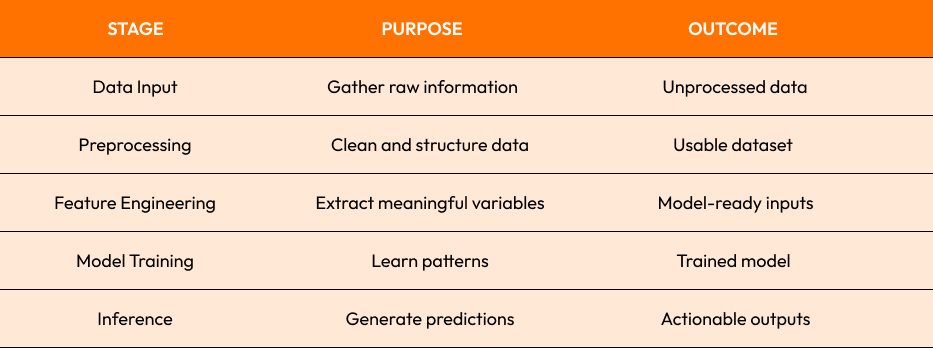
AI systems function via a standardized AI pipeline. This Ai pipeline specifies the route in which data flows, how it is processed and leads to insights generation.
It often begins with raw data unstructured, messy and sometimes incomplete. These can be via user actions, transaction logs, sensors or third-party platforms. By itself, this data is almost worthless.
The pipeline converts this crude input into workable output. It scrubs the data, puts it in order, extracts useful signals from it and eventually ships it into models that churn out predictions.
Data should come to the processing or geoAl platform as there are different pipelines that can be for video real-time streaming, batches of images and streams. Break the pipeline, and bonk! The entire system is unreliable.
Here’s a basic breakdown of how it operates:
Strong opinion:
The pipeline is critically important, but most companies fail to realize it. They concentrate on the model itself, while approximately 90% of the success is due to data processing preceding and succeeding the model.

Data Collection and Preprocessing for AI Models
An AI system cannot be better than the quality of its data. This is why the first step, data collection, is one of the most important.
Data may be sourced from several places:
- Automate sales and marketing processes for faster Customer interactions (clicks, purchases)
- Internal systems (CRM, ERP)
- External APIs or datasets
But raw data is rarely clean. Usually, it includes noise, duplicate records, inconsistencies and missing values. And this is what preprocessing is for. Preprocessing involves:
- Cleaning incorrect or incomplete data
- Normalizing formats
- Removing outliers
- Structuring data for analysis
Even the best AI models would generate unreliable results without this step.
A real-world example:
An AI solution to demand forecasting at a retail firm was unsuccessful in the beginning. Upon auditing their data, they discovered discrepancies in inventory records. After cleaning, 25% more accurately predicted the exact species.
This highlights a key truth:
But AI doesn’t patch data-it amplifies it.
Feature Engineering: Turning Data into Meaningful Inputs
Feature engineering - perhaps the most underappreciated step after data cleaning.
Feature engineering involves selecting and transforming data into meaningful inputs that models can derive from. It’s not merely a matter of feeding data into a system; it’s about feeding the right data.
For example:
- Rather than extracting raw timestamps, you might extract “time of day” or “day of week”
- You do not work with transaction logs, but calculate “average purchase value”
These derived features can often have a higher predictive power than that of raw data.
This step hence involves technical and business acumen. You need to know what signals are important and how they correlate with outcomes.
Better features are often much more powerful than a complex model. Skills and raw features can outperform advanced methods
Strong opinion:
If your model is sub par, likely the issue isn’t with the algorithm; it’s with features.
Model Training: How AI Learns Patterns from Data
This is where the magic seems to work but in reality, it’s a systematic process known as model training.
The process works by feeding the system historical data that it analyzes and learns from to find patterns. This involves modifying internal parameters to reduce discrepancies between predictions and real-world results.
There is a variety of training approaches:
- Supervised learning (with labeled data)
- Unsupervised learning (finding hidden patterns)
- Reinforcement learning (learning through feedback)
The objective is straightforward: to create a model that generalizes, which means it works well not only on past data but also on new, previously unobserved data.
But training must be done repeatedly. It requires:
- Validation to test accuracy
- Tuning to improve performance
- Monitoring to avoid overfitting
One strong example comes from financial services. Trained models are used to identify fraudulent transactions by banks. They’ve drastically reduced fraud losses, re-monitoring models with new data; some estimates put it at 30-50% business improvements.
So, training isn’t just about creating a model; it’s about keeping a tab on that model too.
Inference and Decision-Making in AI Systems
When trained, models go into the real world by way of inference, the phase where predictions are made.
This is where decision-making happens.
For example:
- Use a model that predicts if a user will churn
- The system determines whether or not to send a retention offer
- This is done by an automated process executing the action
This entire flow happens within milliseconds, especially in real-time processing systems.
New AI solutions embed inference directly into business operations. Predictions are not mere outputs; they invoke actions.
Key components involved here include:
- Model deployment environments
- APIs for real-time access
- Monitoring systems to track performance
Take ride-sharing platforms, for example. Their pricing models dynamically tweak fares according to demand, location and time. These choices are made in microseconds, affecting millions of users every single day.
But here’s an important point:
It’s always decisions, not predictions that create value.
If your system generates insights but doesn’t act on them, you’re sitting on the value.

Final Thoughts: From Models to Real Business Impact
Understanding how ai models work isn’t just a technical exercise; it’s a business imperative.
Each and every step in the pipeline, starting from data collection ending with decision-making plays a vital role in the final outcome. Miss one, and the whole system breaks down.
But let’s be honest: implementation is what most businesses struggle with.
Common Challenges:
- Poor data quality
- Lack of clear objectives
- Overcomplicated models
- Weak integration with business systems
Best Practices:
- Focus on data quality first
- Simplicity is the soul of wit in models
- Identify AI initiatives that support business objectives
- Continuously monitor and improve
Gartner suggests that more than 80% of AI projects fall short on business value, not for lack of technology viability, but rather because of dysfunctional implementation.
That’s a harsh truth but also an opportunity.
Businesses that succeed do not merely apply AI; they create intelligent, flexible systems at scale.
Ready to Turn AI Into Real Results?
Don’t stop at just understanding how AI works, if you are serious about making it work in your business. Start making systems that provide real value.
At Crescentic Digital, we guide businesses through AI product design and deployment from data-pipes all the way to production-ready models, engineered for real-world impact.
Ready to transition from experimentation to execution?
Head over to our Contact Page and let’s create AI solutions that don't just work in general but for your business specifically.
Start Your Expert Consultation
Please write your name and contact information below. We will respond as soon as possible.