Ecommerce Technical SEO: Improving Crawlability and Indexation
Many ecommerce sites have thousands of pages, including product pages, categories, filters and dynamic URLs. This scale can create opportunities for ranking in a variety of keyword categories, but it can also present technical challenges which prevent the search engines from discovering or indexing key content. Ecommerce technical seo is critical in this case.
Online stores tend to focus on backlinks and product descriptions while ignoring the technical foundations. Even the most engaging content will not rank well if the search engine is unable to index or crawl the website effectively.
Search engines can better understand your site's structure and discover pages that are important quickly. They will also prioritize content. Improved crawlability and indexation leads to increased organic visibility and revenue.
Search engines are unable to access websites efficiently, which is why many ecommerce companies lose their rankings.
Internal Linking and Website Architecture in SEO for Better Crawlability
Every successful online store is built on a strong website architecture in seo strategies.
Internal links are used by search engines to understand and discover relationships among pages. Crawling becomes more effective when category pages, products, and subcategories are logically connected.
A good ecommerce system typically has a hierarchical structure:
Home page - Categories Pages – Subcategories Pages – Product Pages
The structure is designed to make it easy for users to navigate and also guide search engines towards important content.
The following are key internal linking strategies:
Related Products Linking
Create category-to product relationships
Use descriptive anchor text
Click depths that are shallow
Avoiding orphan pages
Botify conducted a study that found pages deeper in a site's structure receive less crawler traffic and have fewer organic visits.
It is my opinion that if you have to click on five or six pages before reaching important products, then they're already at a competitive disadvantage.

Guiding Search Engine Crawlers: XML Sitemaps and Robots.txt
Search Engine crawlers use technical signals to determine which pages are worth crawling and which ones should not.
This process can be managed with two essential tools:
XML Sitemaps:
XML Sitemaps are a roadmap for the search engines, listing all important URLs on your website.
The following benefits are included:
Faster content discovery
Improved indexation of product pages
Increased visibility of newly added products
Improved crawling efficiency
Dynamic sitemaps are often required for large online stores that have thousands of products.
Robots.txt:
The robots.txt control file allows crawlers to access specific parts of a site.
Exclusions that are common include:
Pages Admin
Sign in to your account
Search results
Filter generated URLs
Sections with duplicate content
Search engines can be accidentally blocked from finding valuable content if robots.txt is configured incorrectly.
One well-known case study in ecommerce showed that a retailer lost substantial organic traffic when they unintentionally blocked important category pages using robots.txt instructions.
Robots.txt, in my opinion, is the single most important file on any website. It's also one of those files where you can make the biggest mistakes.
Improve Index of Websites Through Technical Optimization
Search engines maintain an index of websites to determine which pages will appear as search results.
It is not enough to simply publish pages.
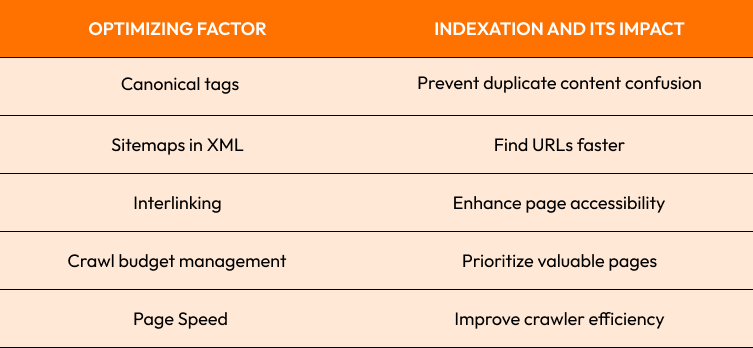
Several factors affect indexation:
Duplicate content is a common problem for large ecommerce sites.
Variations in product
The URL parameter is a set of characters that can be used to identify a website.
Faceted navigation
Page Number
Canonical tags consolidate rankings signals and avoid indexing conflict.
Due to the sorting and filters options, many ecommerce platforms generate multiple URLs. Search engines can waste resources crawling duplicate pages without proper canonicalization.
It is my opinion that indexation does not mean getting all pages indexed, but rather ensuring only the correct ones are.
Google Core Web Vitals and Their Impact on Search Rankings
Google Core Web Vitals has become a key component in modern SEO.
The metrics used to measure the real-user experience include:
- The Largest Containing Paint (LCP):
The loading time of the primary content is measured.
Target:Below 2.5 seconds
- Cumulative layout shift (CLS):
Visual stability is measured during the page load.
Target:Under 0.1
Google evaluates the page's experience using these signals.
Slow performance in ecommerce can have serious business implications:
High bounce rate
Reduced conversion rates
Reduced engagement
Lost rankings
Google's research shows that as the page loading time goes from one to three seconds it increases the likelihood of users leaving.
Walmart is a good example of a company that has seen measurable improvements in conversion rates after improving site performance and speed.
It is my strong opinion that faster websites are ranked higher because of the better experience they provide to users, not because search engines prefer them.
Identifying and Fixing Common Technical SEO Issues
If left unresolved, technical problems can undermine the performance of ecommerce for many months.
The following are some of the more common technical SEO issues:
Broken internal Links:
Broken links are a waste of crawler resources, and they can also harm the user experience.
Replicated Content:
Commonly caused by
Variations in product
Use Filter URLs
Session parameters
Chain Redirect:
The crawling efficiency and loading time of pages are affected by multiple redirects.
Crawl errors:
Inaccessible or 404-pages, errors on the server, and other issues can hinder indexing.
The Thin Content:
Most e-commerce sites rely heavily on the manufacturer description, which can lead to a lack of differentiation and a limited ranking.
The tools used in modern SEO audits include:
Google Search Console
The Screaming Frog
Ahrefs Site Audit
Semrush Site Audit
Sitebulb
Monitoring regularly helps to identify problems before they have a significant impact on rankings.
Technical SEO should not be viewed as a single-time task. This is a continuous maintenance process which directly impacts long-term growth.
Final Thoughts
A strong technical SEO for Ecommerce is the basis of successful organic visibility. Even the best products and content may not appear on search engines if they aren't properly crawled and indexed.
Every technical SEO improvement, from improving the Website Architecture in seo to guiding Search Engine Crawlers to optimizing the Index of websites and optimizing Google Core Web Vitals and Resolving Technical SEO Issues strengthens search results.
Common Ecommerce SEO Challenges:
Internal linking structures are poor
Double content
Budget waste crawling
Slow Page Performance
Indexation inefficiencies
The Best Practices:
Keep a clear hierarchy on the site
Regularly optimize XML sitemaps
Use canonical tags to ensure that you use the correct tags
Check Core Web Vitals regularly
Conduct ongoing technical audits
It's a fact: the ecommerce companies that are at the top of the search engine results have the best technical infrastructure.

Ready to Improve Your Ecommerce SEO Performance?
Crescentic Digital offers professional SEO Development Services to enhance crawlability, indexation and website performance.
Do you want to make sure that your online store is optimized for both search engines and customers?
Our experts can help you create a strong technical SEO foundation to ensure long-term success. Visit our Contact Page now.
Start Your Expert Consultation
Please write your name and contact information below. We will respond as soon as possible.