
Database Optimization Techniques for High-Traffic Web Applications
High volume data transactions and processing takes place in all modern web apps today. Web apps like eCommerce platforms, SaaS products, Streaming APIs, FinTech, etc. Grown web traffic and load level can quickly cause severe performance bottlenecks for unoptimized and poor databases.
Database optimization is critical for modern scaled web systems.
A slow database impacts everything:
APIs
User interfaces and experience
Application resilience
Infrastructure optimization
Search features
Businesses that focus disproportionately to Frontend performance neglect the backend and inefficient database queries at their peril. They will pay that inefficiency for the life of the business.
The strongest and most true statement I can make is that in every instance of the most visible and most painful scalability failures in the most high traffic web apps, the rot began at the database layer.
Database optimization techniques have been sufficiently complicated enough to require unintended distributed architecture and intelligent caching and scaling strategies, and mixed coupling with client and server strategy but will always require constant monitoring.
We will now consider how to optimally scale and manage database performance.
Query Optimization Techniques to Reduce Database Load
Load reduction can be achieved with Query optimization of the database interaction model.
Poorly written database queries can cause even the most powerful databases to choke and suffer from performance loss from the inefficiencies including:
Full table scans
Missing indexes
Complex nested subqueries
Excessive SQL joins
Repeated redundant queries
Optimization of database interaction and reduction of computer resource cost has to be a function of time and application of user workload.
Key optimization strategies are:
Proper indexing
No SELECT *
Returned data limits
JOIN optimizations
Query execution plans
Correct indexing on frequent search columns makes a query return in ms rather than second(s).
Here’s a simple comparison:
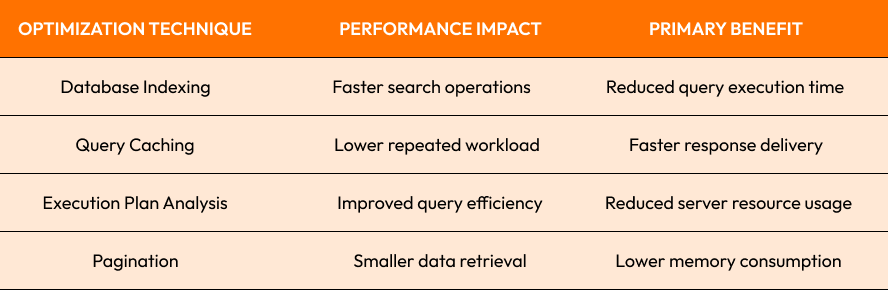
An example is Instagram, where Query optimization of its database during surges in user growth helped avoid a snowball effect and constant database growth.
I also strongly believe that adding more hardware for poorly performing queries is not an optimization but rather a failure to confront the real issue.
Caching Layers and In-Memory Data Storage Solutions
Database requests can get expensive at scale, which is why caching layers are vital for high-performance systems.
Rather than continuously querying the database and needing repeated requests, the data can be served from memory.
Systems almost always implement:
Redis
Memcached
CDN edge caching
Application-level caching
Caching works best for:
Content access that is frequent
Session data
Product catalogs
API data
User preferences
For example, Netflix uses distributed caching systems to reduce the overload of its backend databases on a global scale.
Caching strategies incorporate:
Write-through caching
Cache-aside patterns
Time-based expiration
Distributed cache synchronization
Handling caching issues can quickly become complex due to the potential for stale data and inconsistent caches.
Strong Opinion:
An architecturally sound system will not perform the same expensive queries thousands of times a minute.
Database Scaling: Vertical vs Horizontal Scaling Approaches
As user demand grows, a database will eventually reach a point necessitating scalability. There are two primary scaling methods:
Vertical scaling
- Horizontal scaling
A CRM updates a lead status
Vertical scaling refers to the addition of resources to the server, including:
More powerful CPUs
- More RAM
Faster storage
This is a simpler approach at the onset, but there are limits to hardware.
Horizontal scaling, on the other hand, relies on many database nodes to distribute the workload. Instead of one large server, throughput is shared by many smaller servers.
Here's a comparison:

With the demands of modern applications, Horizontal Scaling is preferred due to an increase in:
Robustness
Availability
Fault Tolerance
Improved distribution (spatial and temporal)
These considerations are why companies like Amazon and Uber rely on distributed architectures, as centralized databases struggle with the demand of a growing customer base.
Use of a containerized infrastructure along with Kubernetes allows for the automation of distributed architecture.
Strong Opinion:
If the sole focus of your database scaling is to purchase larger servers, your architecture is not designed for the long term.

Replication, Sharding, and Load Balancing in Distributed Databases
At scale, Distributed Databases become a necessary solution for reliability. These three techniques allow for efficient load distribution and redundancy:
Replication
Data is copied to multiple servers for redundancy and improved read scalability.Sharding
Data is segmented and distributed to multiple servers.Load Balancing
Workload demands are distributed across multiple database instances.
Sharding is necessary for larger datasets that can't be managed by single-server architectures alone.
Some examples are:
User data can be partitioned by region.
Tenant data can be divided by customer group.
Traffic can be routed in real-time depending on workload.
Facebook was one of the first companies to use database sharding in order to support billions of users and interactions.
Some of the issues that come with sharding databases are:
Replication lag
Cross-shard query complexity
Failover handling
Data consistency
The reason why distributed systems are useful is because they are scalable, but they are also able to show all the flaws in an architecture.
Monitoring Database Performance and Identifying Slow Queries
Continuous monitoring is important, but often neglected when it comes to Database Optimization.
Databases very rarely fail without warning. Performance issues usually occur because:
Queries are slow.
The CPU usage is constantly rising.
Lock contention is growing.
Memory usage is getting higher.
Some of the metrics to be monitored include:
The execution time for each query.
Read/write latency.
The hit rates for the cache.
Replication lag.
The usage for the connection pool.
Slow query logs are important and very useful because they tell inefficient operations that occur in the database.
According to research from Google Cloud, the best way to reduce the chance of downtime for databases at a high scale is to implement monitoring tools.
An example of this comes from Shopify and how they maintain stability when there are massive spikes in ecommerce traffic because they have monitoring tools for their database in real time.
Strong opinion:
Most database outages are not caused by sudden traffic; they were caused by ignoring the signs for too long.
Final Thoughts
Strong Database Optimization strategies are necessary in order to build systems that are high-performing, reliable, and scalable.
From Query Optimization to intelligent caching, from Horizontal Scaling to Distributed Databases, modern architectures require far more than simple database setup.
Most modern architectures require more than a basic database setup.
Issues faced by most databases include:
Caching
Indexing
Scalability
Queries
Analytics
Practices to employ include:
Caching
Horizontal scaling
Monitoring
Distribution
Strong opinion:
Database performance is not just an engineering concern; it directly affects user trust, scalability, and business revenue.

Ready to Optimize Your Database Infrastructure?
Well, you can retain customers and scale your business with a reliable and robust database system from Crescentic.
We design systems that can anticipate your growth.
Just visit the Contact us page . We would like to help you design systems that would serve continual growth.
Start Your Expert Consultation
Please write your name and contact information below. We will respond as soon as possible.