
Data Driven Content Marketing: Using Analytics to Guide Content Strategy
There is a lot more to content marketing than just writing blog posts. Successful brands incorporate analytics and insights into the content they produce for their audience. With the right data, smart decisions can be made. Data driven Content marketing becomes a competitive advantage.
Today’s effective content strategies involve user behavior, data on searches, keywords, trends, and conversions. Every piece of content created should promote goals like greater visibility, more leads, and ultimately, sales.
Creating content without analyzing data is the same as driving with a blindfold. You might eventually get where you are going, but it will be painfully slow.
Companies that succeed in promoting their content through the use of analytics consistently receive greater engagement and return on investment.
What is a Content Strategy and Why Analytics Is Essential for Content Strategy Success
When businesses ask what is a content strategy, they are relaying their confusion as to why content strategies are crucial for businesses.
A content strategy can outline:
Goals for the business
The audience
Topics for the content
Channels to publish on
How success will be measured
Content strategies can make scaling marketing efforts much easier.
By incorporating analytics into your strategy, you can shift your planning from guesswork to planning driven by data and facts.
Analytics can assess:
The flow of traffic
User Interactions
The performance of your content
Rates of conversion
Interests of your audience
For instance, Google Analytics, alongside Search Console, can help you understand what users are interested in, how they are reaching your website, and what conversions are being achieved.
We can confidently say content shouldn't be produced because it's expected. Data and facts should support the reasoning for publishing the content.
Using Search Intent Analysis to Produce Meaningful Content
One of the most essential aspects of content production and planning today is Search Intent Analysis.
Search Intent can be defined as the reasoning behind the query conducted by the user. Closely knowing and understanding this search intent can help you accurately produce the content your audience is looking for.
Search Intent can be classified in four main ways:
Informational
Navigational
Commercial
Transactional
As an example of each, consider the following:
"What is cloud computing?" has an example of an informational intent.
"Nike Shoes" has an example of Navigational intent.
"Best CRM software" has an example of a commercial intent.
"Buy running shoes online" has a transactional intent.
When the content produced matches the user's intent, it's more likely that a search engine will produce this content since the content meets the user's needs.
HubSpot is an excellent example of a company that has garnered a lot of organic traffic by focusing on content that meets the varying stages of the customer journey rather than just writing content for high-volume search terms.
Effective intent analysis considers:
SERP analysis.
Competitor analysis.
Query analysis.
User journeys.
Strong opinion:
Ranking for the wrong intent can create traffic but doesn't create value for the business.
Building Topic Authority with Keyword Clustering
SEO focuses more on topical expertise than strict keyword targeting. As a result, "keyword clustering" as a strategy is becoming more critical.
"Keyword clustering" involves finding a group of related search terms, and arranging them into a large, overarching topic.
Separating search terms for all of their variations is less efficient than creating many interconnected content pages to cover related content.
A good example is a digital marketing page that clusters around the terms:
SEO
Content Marketing
Technical SEO
Link Building
Search Analtycs
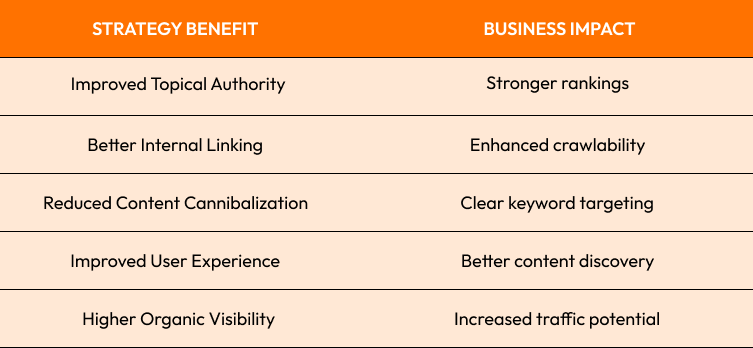
The advantages of keyword clustering is comprised of:

Topic clusters, along with supporting articles and pillar pages, are a good strategy to send more authority signals.
Strong opinion:
Search engines favor covering topics thoroughly. Publishing unrelated content caps maximum growth.

Better Rankings and Engagement through Content Optimization Frameworks
It's not enough to publish content. The practice of publishing content must be paired with continuous "content optimization" to be ranked and receive traffic over a long duration.
Optimization is when you improve content from analyzing how customers actually use the content and how well it performs in searches.
You can focus on optimizing in the following areas:
Content Freshness:The relevance and accuracy of content can be improved by updating it regularly.
On-Page SEO:
This means optimizing the elements such as:
Titles
Meta descriptions
Headers
Internal links
Structured data
User Experience
The following can improve user experience:
Readability
Mobile responsiveness
Navigation
Page Speed
Engagement Signals
This includes monitoring:
Time on Page
Scroll Depth
Bounce Rate
Conversion
An example study by Semrush showed that time was saved and efficiency increased by updating old content vs writing a new article.
The ongoing process of content optimization is critical.
Strong Opinion:The content that optimizes the best is usually the content that has been actively edited the most.
Content ROI and Conversion
Justifying the cost of a content piece is a challenge, and for this reason, evaluating Content ROI is important.
Content ROI examines if investments in content are paying back.
Some content optimization metrics include the following:
Organic Growth:
Noted improvements in visibility.
Lead Generation:
This includes new contacts and downloads.
Conversion Rate:
This answers how well the content did the action.
Revenue:
This connects the content work and profit.
Customer Acquisition Cost:
This helps to evaluate the content cost of new customers.
Too many organizations only look at page views. The most important measure of success is less traffic and more business.
A B2B software company may get much less site traffic than a media company or similar business, but the value of that traffic may be much greater if those visits turn into sales leads.
Some tools that generate return on investment calculations include:
Google Analytics 4
HubSpot
Salesforce
Looker Studio
Semrush
Strong opinion:
Content that gets site visits but does not generate revenue for the business is not a success.
Final Thoughts
Successful Data driven content marketing relies on facts and Logic.
Businesses that recognize the need for a solid Content strategy, conduct thorough search intent analysis, apply Keyword clustering, improve Content roi, and therefore enhance Content Optimization will be able to produce content aligned with the needs of their audience and their business.
Common Content Marketing Hurdles:
Publishing without a clear cut plan
Neglecting on-site search intent
Poor topic coverage
Minimal optimization
Unmeasured ROI
Good Habits:
Make decisions based on facts and metrics
Tailor content based on user intent
Strategically construct topic clusters
Consistently optimize previously published content
Regularly assess business impact
Strong Opinion:
The brands that dominate the search rankings are producing the least amount of content. They are the ones producing the most relevant content based on the most relevant data.

Want to Build a Content Strategy That Actually Works?
Crescentic Digital works with businesses to build content strategies that work using analytics, SEO, and other data-driven marketing strategies.
Are you looking for content that reaches the ideal target audience, has improved search visibility, and helps your business grow?
Contact us today so that our professionals can get you started with content creation that will help your business grow for years to come.
Start Your Expert Consultation
Please write your name and contact information below. We will respond as soon as possible.