
Conversion Rate Optimization (CRO): Data-Driven Strategies for Higher Conversions
Bringing people to a site is only part of the work. The challenge is converting people to patrons, subscribers, or leads. Plenty of marketing channels (such as SEO, paid ads, or content marketing) can bring traffic, but those channels can be a waste of time and resources if a website does not have a high visitor conversion rate. This is where conversion rate optimization comes in.
CRO is the practice of increasing the rate at which users complete a goal on a website (such as making a purchase, submitting a form, signing up for a newsletter, or requesting a consultation).
Successful CRO is not an opinion-based practice. It relies on data to articulate problems, and experiment and evolve in the right direction.
My strong opinion is that greater site traffic does not positively correlate to greater revenue. In many scenarios, the more beneficial practice is allowing site visitors to complete goals instead of driving more traffic.
Businesses that aim to refine user experience outperform competitors without the need of a larger marketing budget.
Why Data-Driven CRO Matters for Business Growth
A lot of site decisions and changes are made based on personal preference, and are not evidence (making those changes, especially for CRO, not very effective). Most of the time, data and evidence are not available and decisions are a shot in the dark-businesses have the most success when the decisions are informed by user data.
A data-driven strategy leads to a better understanding of:
Where site visitors drop off during conversion
In which path (of clicks) do the visitors end the conversion goal?
What are the roadblocks to conversion?
Which site elements or features are the most persuasive?
Now, instead of guessing, changes can be made based on the real use of the site, and the outcomes can be measured.
Forrester's research indicates that companies that use data-driven strategies achieve stronger customer engagement and broader marketing wins.
For example, a company running an ecommerce store may find, using data, that users find shipping costs frustrating and leave the store before checkout is complete. If the ecommerce store cannot see shipping in the checkout process, they may leave. The store may use data to fix this problem by offering shipping options early in the shopping process, and in multiple ways. Options and costs may be included in an early step, a shopping cart option, or a checkout step.
Assumptions about data will cost the business money. Data shows how users interact with the solution, and the business may use this to satisfy the customer.
Using Data to Understand User Behavior
Successful CRO starts with the business's understanding of user behavior.
Analytics Tools and session tracking tools provide data and do a great job of recording user sessions and showing the user journey before a desirable (or less desirable) goal is completed.
Some tools to aid in CRO include:
Google Analytics
Microsoft Clarity
Hotjar
Crazy Egg
FullStory
Some of the data points these tools may track:
User clicks
User scroll depth
User paths
Session recordings
Heatmaps
Heatmaps show the user's journey, which data may be recorded to design the optimal user engagement experience.
CRO is proving that user data almost always shows the data before a user conversion shows the data to the business.
Improving Website Performance With A/B Testing
A/B Testing is proving to be an excellent CRO tool.
A/B testing analyses two displays or designs to determine which has superior performance.
Instead of altering an entire site, companies can alter parts of constructs like:
Text
Buttons
Graphics
Fields
Pricing
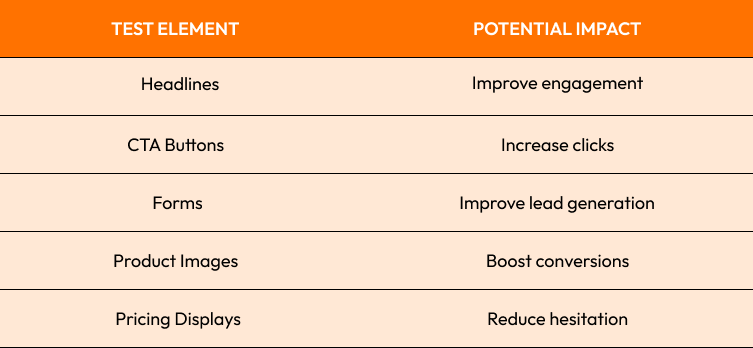
Some of the more common aspects and the effect of testing those aspects:

Booking.com is an example of a company with many tests to fine tune their conversions and user experience.
Find a problem
Explain the problem and how to fix it
Develop alternative solutions
Analyze the effect of the solutions
Substitute the solution with the highest positive effect

Many of the best landing pages followed the landing page optimization guidelines.
The most important part of a landing page optimization is the first impression it has on the potential customer.
The page should:
Provide instant and easy to understand value
Provide and easy reason to trust the page
Provide a clear pathway to the most important task of the page
Key optimization techniques include:
- Clear Value Propositions
Users should understand what is being offered within seconds.
- Strong Visual Hierarchy
Important information must stand out through strategic layout, spacing, and typography.
- Trust Signals
Risks to customers are lessened by reviews, testimonials, certifications, and guarantees.
- Mobile Optimization
Since mobile traffic dominates many sectors, it's crucial for sites to deliver an optimal mobile site experience.
According to a study done by Google, mobile site traffic abandonment from users is very common when sites do not provide a good mobile experience.
Shops like Shopify optimize their landing pages by messaging and distracting less.
Strong Opinion:
Landing pages should contain only one goal. Everything else detracts from conversion.
User Friction and the Conversion Funnel
A Conversion Funnel is the pathway that users take from the first contact to the conversion.
At any point friction is an issue, and users are likely to abandon the process.
Friction is introduced by:
Difficult forms
Surprise costs
Slow pages
Account creation
Intrusive site navigation
Friction can be easily solved.
An example of this is the invention of the one-click purchase by Amazon, which created an optimized system for eliminating friction between purchase intent and the conversion.
Important forms of friction reduction include:
Simplified purchase checkout
Fewer form fields
Faster pages
Clear guest checkout
Clear guides to track progress
Funnel analytics should be regularly reviewed to address friction in the conversion process.
Strong Opinion:
Every additional step in a conversion funnel gives users another reason to leave.

Important CRO Metrics And How They Are Measured
An important aspect of effective site optimization is the continuous and habitual tracking of vital CRO Metrics.
If measurement is not done, businesses will have no way of knowing if their site changes positively impacted users.
Some of the metrics that are most useful are:
- Conversion Rate
Tracks how many users perform the desired actions.
- Bounce Rate
Tracks how many users leave without performing any actions.
- Average Session Duration
Tracks how long users are active, showing how engaged users are.
- Cart Abandonment Rate
Very important for ecommerce sites.
- Cost Per Acquisition (CPA)
How much it costs to get a new customer.
- Revenue Per Visitor (RPV)
How user actions affect a business.
These are the metrics that determine which business practices to optimize most in order to achieve the best growth.
For example, a conversion rate lift from 2% to 3% may look small, but if the site has thousands of visitors in a month, there will be a pretty big difference in revenue.
Strong Opinion:
Successful CRO programs are focused on real business metrics and not vanity metrics.
Final Thoughts
Real CRO is not about the sense of tricking users or persuasion, or redesigning the site every few months. It is all about helping users achieve their goals, like breaking down barriers and making things easier.
From all of the different forms of analysis of user behavior to all the different ways that CRO metrics can be used or altered, every single action taken in conversion rate optimization can greatly impact and improve the performance of the business in a positive way.
Some challenges related to CRO:
Landing pages that do not convert
High abandonment rates
Lack of conversion rate split testing
Lack of conversion rate data
Recommendations:
Set data driven goals
Run more tests
Focus on the data that matters
Optimize for mobile
Simplify the user journey
Strong Opinion:
Companies that continuously work on CRO improve their competitive advantage by increasing the value of their customers.

Want to Improve Your Site's Conversions?
Crescentic Digital can help with structured conversion rate optimization, user experience, and design with analytics.
Do you want to turn visitors to your site into customers and make the most out of the value of your site visitors?
Fill out the form on our contact page for a growth focused conversion strategy.
Start Your Expert Consultation
Please write your name and contact information below. We will respond as soon as possible.