Building Multi-Tenant SaaS Applications: Architecture and Scalability
SaaS Applications have become a competitive advantage for modern businesses, as they’re less expensive and simpler to use and deploy. Unlike traditional software, they can handle exponential growth with ease. Though they may seem frictionless on the surface, behind the curtain, successful SaaS platforms build and architect for performance and security while adding as many customers as needed.
This is exactly why building multi-tenant SaaS architecture is so vital.
In this architecture, multiple customers (or tenants) use the application while their data is kept discrete and secure. This architecture model is used by applications like Shopify, Slack, and Salesforce, allowing them to quickly and efficiently serve customers across the globe.
Though multi-tenant systems are a good idea, they’re a complex build and can present serious challenges like:
- Security holes
- Performance issues
- Complicated databases
- Keeping your tenants data separate
Strong opinion:
There are great ideas for SaaS products, but many fail due to the architecture not being built for scale.
To ensure a successful product launch, common scalable multi-tenant architecture targets with single-tenant vs multi-tenant architecture model will be examined.
Single-Tenant vs Multi-Tenant Architecture: Key Differences
The biggest architectural decision when building SaaS Applications is choosing between single-tenant and Multi-Tenant Architecture.
In a single-tenant model:
- Dedicated infrastructure per customer
- Databases and services are unified
- Customization is more complex
- Higher operational costs
In a multi-tenant model:
- Combined customer infrastructure
- Centralized resources
- Resource scalability is easier
- Lower operational costs
Here’s a simplified comparison:
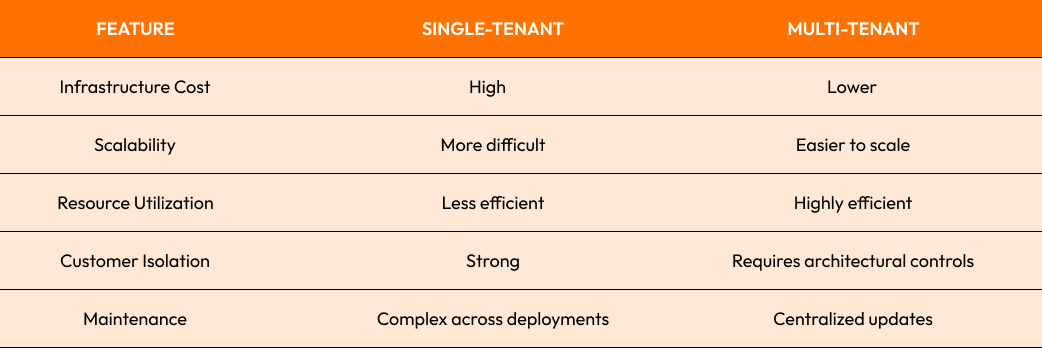
Salesforce was able to become one of the largest SaaS companies because their multi-tenant model gives them the option to rapidly scale their offering without a significant amount of duplicated infrastructure.
As a counterpoint, multi-tenancy is inherently difficult engineering. Our shared environments are prone to less customer separation and require smart resource management.
Strong opinion:
If your SaaS product will likely scale globally, choosing a model that is not multi-tenant will likely increase your operational pain in the future.

Tenant Isolation Strategies and Data Security Considerations
One of the major challenges in Multi-Tenant Design is ensuring that Data Security between tenants is maintained.
Failing to do so not only compromises the integrity of the tenants' data but also catastrophically damages customer trust.
Several isolation strategies exist, and a customer base will choose one:
- Shared Database, Shared Schema
All tenants share the same tables, separated by tenant IDs. - Shared Database, Separate Schema
Each tenant gets its own schema inside a shared database. - Separate Databases
Each tenant has an isolated database instance.
Each of these approaches balances:
- Cost
- Complexity
- Security
- Scalability
In more heavily regulated industries, additional isolation, and more complex models are usually required.
Security requires several essential techniques, such as:
- Row-level security
- Encryption at rest and in transit
- Tenant-aware authorization
- API access restrictions
- Audit logging
Focusing on tenant isolation is critical for Microsoft Azure SaaS guidance. When designing cloud-native applications, one of the core design principles is tenant isolation.
Strong opinion:
Weak tenant isolation is one of the fastest ways to destroy trust in a SaaS platform
Security mistakes in shared systems scale as fast as the products themselves.
Database Design Approaches for Multi-Tenant Applications
Efficient Database Design is one of the most challenging components of building scalable SaaS Applications.
As the number of tenants increases, databases must handle:
- Massive concurrent requests
- Complex queries
- Isolated tenant data
- High availability requirements
The most common approaches include:
- Shared relational databases
- Schema-per-tenant models
- Database-per-tenant models
- Distributed NoSQL systems
Tenant databases incur major challenges of an operational nature for small SaaS startups that begin with shared, operationally inexpensive databases. Frequent movement toward hybrid approaches for improved scalability and tenant data isolation, along with more extensive operations, is commonplace for large enterprise SaaS. The choice of a specific partitioning strategy for the workload and data for tenants, as well as sharding techniques, can dramatically impact the level of scalability the SaaS achieves.
The most common database systems in SaaS are:
- PostgreSQL
- MySQL
- MongoDB
- DynamoDB
- CockroachDB
A great example of this is that Shopify's significant investment in developing database sharding has allowed them to support millions of merchants.
Strong opinion:
Most database scaling problems are architectural problems, not problems with the database technology.

Scalability and Performance Optimization in SaaS Platforms
The foundation of successful SaaS systems is scalability. Without proper performance optimization, applications become unstable as customer growth increases.
Modern SaaS applications need to provide:
- Support for thousands of users
- Support for real-time processing
- Support for consuming global traffic
- Support for large volumes of API requests
Important scalability techniques include:
- Horizontal scaling
- Load balancing
- Use of caching
- Processing via queues
- Processing via queues
- Use of Content Delivery Networks
- Use of Kubernetes for container orchestration
This is where:
- Rate limiting
- Tenant quotas
- Auto-scaling policies
Are useful.
Google Cloud indicates that medium-sized latency improvements can result in great user retention and improved user engagement on SaaS platforms.
An example of a massively scalable platform is Netflix; the use of distributed systems allow their platform to be reliable and load massive traffic.
Personal opinion:
Scaling should be used for stabilizing and predictable growth instead of surviving spikes in traffic.
Access Control, Authentication and Authorization for Multiple Tenants
In a SaaS architecture, managing user access across tenants is one of the most challenging and sensitive engagements.
Robust Authentication and Authorization systems ensure that users gain access to the correct tenant resources.
The access control mechanisms may vary, but commonly include the following:
- Role-Based Access Control (RBAC)
- Attribute-Based Access Control (ABAC)
- Single Sign-On (SSO)
- Multi-Factor Authentication (MFA)
- Tenant-aware JWT tokens
A typical pitfall is treating authentication and tenant verification as separate. Actually, they rely on one another.
Example of this would be:
User identity is incomplete if there is no verification of tenant ownership and permissions.
Modern SaaS platforms often use:
- OAuth 2.0
- OpenID Connect
- SAML Authentication
An example of a practical use case is Slack, where strong tenant separation is maintained, yet access controls can be provided for multiple users across multiple tenant systems.
Suspicious login activity and session security must also be maintained in large scale SaaS systems.
Strong opinion:
Weak authorization logic creates some of the most effective and dangerous vulnerabilities in multi-tenant systems because a single mistake can endanger a whole collection of customers.
Final Thoughts
We must consider more than writing working code when creating usable SaaS Applications. For long term concurrency, we must consider foundational architecture.
From Database Design to Performance Optimization, from Data Security to Authentication and Authorization, every layer of the architecture builds scalability, while also building confidence in the customer.
Some of the more common frustrations in Multi-Tenant use:
- Weak tenant separation
- Database bottlenecks
- Resource contention
- Over complex access controls
- Poor performance and consistency
A few suggestions:
- Build tenant separation into the systems early
- Choose separation of databases strategies that can grow
- Watch resource use across tenants consistently.
- Centralize Authentication
- Stress Automation and ignore manual scaling
Strong opinion:
The most successful SaaS offerings are more than just operational, they perform reliably across a diverse and extensive user base.

Ready to Build Scalable SaaS Platforms?
Employing secure multi-tenant architecture and designing a workforce that can control performance over the long term is what we aim to accomplish for our clients here at Crescentic Digital.
To begin, we will focus on designing a platform that is built for growth from the very first design. Contact us today and let's get started!
Start Your Expert Consultation
Please write your name and contact information below. We will respond as soon as possible.