
Building End-to-End Intelligent Workflows with AI Automation Systems
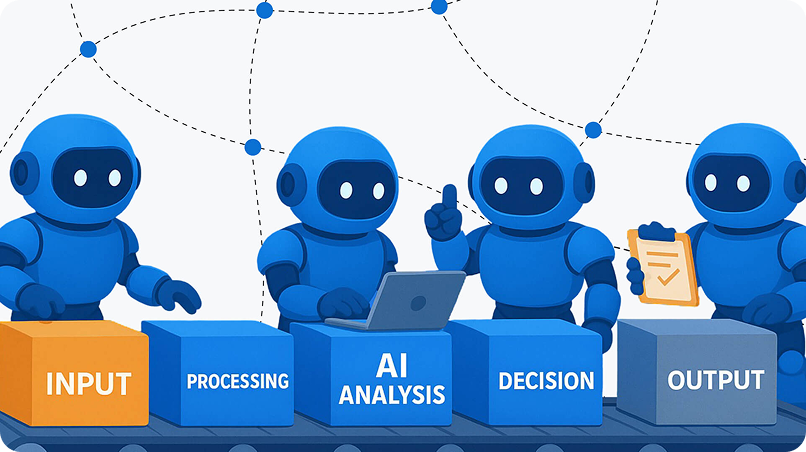
The AI Automation Systems involve a fundamental change to how a company operates. Instead of reacting to and completing tasks one by one, companies now can architect entire systems that think, decide and act throughout entire processes. That’s what AI automation actually means, not saving time, but constructing workflows that can operate with a much lower human factor (while still getting better).
At its best, the automation of AI links tools, data and decision-making into a single continuous loop. It lays out how your lead gets captured to sale closure, or the detection of a problem and its instant resolution; everything becomes part of an organized smart system. The true advantage is not merely speed, it’s consistency, accuracy and scalability.
Let’s look at how these systems work in practice and how you can build them well.
Core Components of an AI Automation Workflow
A few core components form the basis of every successful ai automation workflow. Skip one, and the system gets weaker or less efficient.
First, you have data pipelines. These gather and transit data from multiple sources - websites, CRMs, apps - into a single repository. Poor quality, unstructured data will result in artificial intelligence failing to work no matter how advanced it may be.
Next comes Workflow Orchestration. Consider this as the control center that determines next steps. It guarantees that tasks run in a consistent manner, at the proper time, with no colliding execution.
Then there’s the intelligence layer driven by Decision Engines and machine learning models. This is where criteria get applied, whether this lead is a qualified one, whether that transaction looks risky or what should happen next.
Execution is performed using a process automation tool (such as Robotic Process Automation (RPA) and/or APIs. These enable systems to take actions like sending emails, updating records, and even calling out foreign services through API Integration.
Very lastly: Strong Systems have Feedback Loops. These gather outcomes and report them back into the system, leading to better performance with time. An easy way to think about this:
Inputs → decisions → actions → learning from outcomes That’s the guts of any smart workflow.

Designing End-to-End Intelligent Workflows
Intelligent workflows design isn't simply a matter of cobbling tools together. It’s about creating a system that makes sense from the first step to the last.
First map the entire journey. For instance, in the case of a sales process:
A user fills out a form
The system evaluates the lead
A lead is given or nurtured
Follow-ups are triggered automatically
And now, where previous approaches were separate steps this becomes a continuous flow thanks to Event-Driven Architecture. The next action triggers automatically, and not manually.
Microservices Architecture-based architecture is a robust strategy for dividing workflows into smaller services. This makes the system flexible. You can change one aspect and nothing else breaks.
The 3rd key component is Real Time Processing. Delayed actions kill efficiency. And if a lead expresses interest, the system needs to respond immediately, not hours later.
Here’s a case study to take note of: One SaaS company used end-to-end automation for the entire lead management system. They paired real-time scoring with automated follow-ups to boost their conversion rates by 35% without doubling (or tripling) manual workload.
The reality is that automation is overcomplicated by most companies. They add tools without structure. The winning formula is straightforward: flow first, tech second.
Triggers, Decision Engines, and Action Layers Explained
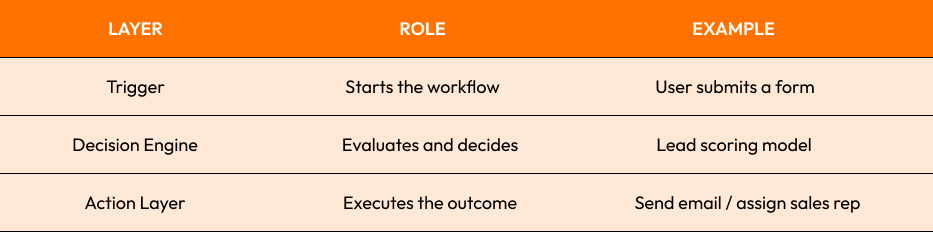
Every ai workflow is built upon three core layers: trigger, decides, and actions.
The process starts with triggers. These could be:
A form submission
A purchase
A user clicking a link
Triggers are immediate and deterministic in a well-designed system. They work in an Event-Driven Architecture, where every event triggers a chain reaction.
Next comes the Decision Engines. This is where the thinking part comes into play. Instead of hard-coded rules, these engines rely on data and models to determine what the appropriate response is for any given situation.
- For example:
Is this lead worth prioritizing?
Should this transaction be flagged?
What message should be sent?
These decisions are frequently propelled by machine learning models which enhance over time with Feedback Loops.
Finally, the action layer acts on the decision. This could involve:
Sending an email
Assigning a task
Updating a CRM
Triggering another system via API
API Integration and automation tools such as RPA, play a significant role in this layer.
Here’s a simple breakdown:
Without alignment of these three layers, the system fails. But when they work in concert, you end up multi-faceted. self-running process.
Combining AI Automation with Business Systems
Automation of AI has no value by itself. It should be integrated with existing business systems to provide real value.
Already most business systems are using tools such as CRMs,ERPs and marketing platforms. The challenge isn’t to replace them, it’s to connect them.
This is where API Integration plays a big role. APIs widely help systems to talk and exchange real-time data. Without this, automation is slowed and disconnected.
Sending an email
- For example:
A CRM updates a lead status
It is automatically picked by the automation system.
A follow-up campaign is triggered
Data pipelines run in the background and ensure information flows seamlessly between computer systems. Then comes Model Deployment where AI models go live and start making decisions in the workflow.
Let me use a real-world example: An e-commerce company connected its inventory system with AI-powered demand forecasting. And by synchronising data across platforms, they reduced stockouts by 25% and improved delivery times considerably.
Strong opinion:
You only have chaos if your systems do not speak with each other and you cannot achieve automation. Integration is not optional. It’s the foundation.
Although the potential is huge, there are challenges in deploying AI automation.
- 1. Poor Data Quality
Bad data means bad decisions. Even sophisticated systems fail without clean inputs.
- 2. Overengineering
Most go to the extreme and try to build complex systems from day 1. This causes delays and confusion.
- 3. Lack of Strategy
Just Doing Automation for the Sake of It Is Busywork There must be a reason behind every workflow.
- 4. Integration Issues
When tools or platforms are disconnected, they do not facilitate efficiency; rather they become a choke point.
Here’s the right way to go about it:
Start small, then scale
Focus on high-impact workflows first
Ensure strong data pipelines
Design your build systems with flexibility in mind
Continuously improve using feedback loops
According to a report from Deloitte, organizations with structured automation strategies realized productivity gains up to 40% higher than those without clear planning.
The difference isn’t technology—it’s execution.
Final Thoughts & What to Do Next
AI Automation Systems are the smarter way to run your business. Designed well, they eliminate manual work, increase accuracy and open doors to growth that were once unattainable.
But here’s the reality:
Many businesses are still mired in disconnected processes, manual tasks and slow decision-making.
More than just tools are needed to remain competitive. You need a system, a well-engineered ai automation architecture that links the dots between the data and decisions and actions.
That’s where we come in.
At Crescentic Digital, we guide organizations to design and deploy end-to-end intelligent workflows that achieve results, not just promises.
Want to create automation that runs itself while you work on scaling?
Go to our Contact Page and let us build you a system that actually gives you an advantage.
Start Your Expert Consultation
Please write your name and contact information below. We will respond as soon as possible.