
Build Scalable Applications Using Cloud Based Software
Cloud software builds fast and flexible apps, resilient to changes and providing superior user satisfaction. Software at scale used to be a solution offered by a few service providers, but as the industry has evolved, so has the technology and cloud based software. Cloud software is here to stay. The transition from monoliths to microservices is an early step for many startups, while larger businesses often need to keep up by adapting from legacy systems. Both refactorings and more cloud-based systems change the design, the build, and the operation of the software. This article focuses on the development of cloud software and offers practical strategies to improve the operation of apps in the cloud, optimize the code, and speed up the software deployment. Insights from different industries will be offered, as well as one of the most famous case studies, to see the implementation of these ideas.
Cloud Application Development Creates Flexible and Scalable Solutions
Cloud application development means the cloud’s features need to be designed into the software. These features include computing power, storage, and services that scale with demand and are distributed world-wide. The services can be designed to expand and contract elasticity, saving money and improving availability.
The first step is to divide the app into different services; these can be the smallest groups of functionality called microservices, or they can be modules that are larger and grouped by context. Next, employ the services that are already implemented to provide the messaging, caching, and database needs of the app. Ensure that the infrastructure provisioning is automated to eliminate chaos while scaling the services. In my experience, no team has been able to achieve consistent scaling without automated chaos.
In one research study, organizations migrated their main apps to a cloud-based system, and the participants reported a 30-50% reduction in the time it took to launch new features as well as a 40% reduction in the operational costs associated with them.
Improving Application Performance in Cloud-Based Environments
Application performance issues can be hidden by the cloud and their use can improve performance as well. Areas of pitfall would include latency, cold starts and resource inefficiency.
Performance can be improved in the following ways:
- Scale profiling: on cloud applications, end-to-end latency should be analyzed, in contrast to on-prem latency where the focus is only on CPU latency. Slow paths can be identified through distributed tracing.
- Resource right sizing: autoscaling should be implemented with the provision of upper and lower bounds limits to achieve resource right sizing.
- Edge and CDNs: assets should be distributed and located as close to edge users as possible in order to achieve low latency.
- Data access optimization: for workloads with heavy read and write operations, using read replicas, caching and partitioning can be helpful.
It is my considered opinion that the combination of performance engineering and the cloud's autoscaling features should be employed if predictable cost and user experience are desired. Autoscaling is only an engineering feature.
Example: Netflix: possesses several hundreds of individual microservices. The combination of edge caching, advanced routing and chaos engineering has enabled them to maintain a low initial latency experience.
Best Practices for Code Management in Cloud Software Projects
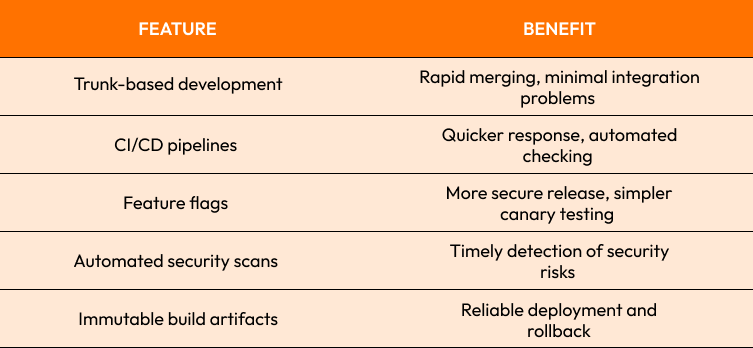
Integration chaos is the inevitable result of poor code management in large project teams. Frequent mergeability (trunk based development) must be the branching style and must be the practice of cloud project teams. Augment this with CI/CD pipelines to boost etiquette.
Key practices:
- Use feature flags to decouple release and deployment.
- Integrate static analysis, security checks and dependency scans in pipelines.
- Build small and immutable artifacts to enable reproducible builds.
Benefits and Features of Modern Code Management :
Strong Opinion: heavyweight branching models and long-lived branches slow teams down. If your team still relies on month-long merges, prioritize adopting smaller, frequent integrations first.

Streamlining Software Deployment with Cloud-Based Software
Software Deployment in the cloud should be predictable and reversible. Use CI/CD to automate build, test, and deploy steps. Canary releases, blue/green deployments, and progressive rollouts reduce risk when introducing changes.
Also, leverage managed deployment platforms (serverless functions, container services with orchestration) where they make sense - they shift boring operational work to the provider and free your team for product innovation. But don’t blindly adopt managed services: evaluate cost, vendor lock-in, and observability trade-offs.
Data-driven insight: teams that use mature CI/CD practices deploy 200+ times more frequently and recover from incidents 24x faster than low-maturity teams, per industry benchmarking reports.
- Automate everything from builds to infra changes.
- Keep deployments small; one logical change per release.
- Monitor deployment metrics and roll back automatically on failures.
- Use chaos-testing in staging to validate rollback paths.
Conclusion:
Cloud based software transforms how teams build and run applications but it requires deliberate patterns: modular design, performance observability, disciplined code management, and automated deployments. If you want to scale confidently, adopt these practices, measure relentlessly, and prioritize predictable delivery over flashy architecture.
If you’re ready to move faster and build resilient, high-performing systems, visit our contact page to schedule a consultation on cloud software development services and get a tailored plan that matches your needs.
Start Your Expert Consultation
Please write your name and contact information below. We will respond as soon as possible.