
API Gateway Architecture for Modern Web Applications
The web application architecture design, modern applications and digital products rely on distributed systems like never before. Rather than building a monolithic backend, companies use hundreds of services all connected by APIs. This newfound ubiquity has transformed the API Gateway from a simple component into an essential part of any modern infrastructure.
API gateway At the very basic level, an API Gateway is basically a single point of entry for all client requests. This approach means that instead of your clients directly talking with individual services, all the communication goes through this central layer. It manages routing, authentication, rate limiting and request transformation.
API Gateway, In the present-day ecosystem, enterprises use it to make communications easy and secure while also optimizing complex systems for better performance. Without it, the management of modern applications created on distributed systems becomes a mess rapidly.
Strong opinion:
APIs are often the main roadblock to scaling in (what we think of as) modern applications today; it's not microservices that are the problem.
So let us go through actual working of how API Gateway architecture works and why it has become a need to have.
API Gateway in Modern Web application architecture
API Gateway: The API gateway is a server-side application that sits between the client and one or more backend services. It is a traffic controller in the web application architecture of modern web applications, routing every incoming request to its corresponding microservice.
API Gateways instead of exposing several services directly, provide a single point into which everything is simplified.
Key responsibilities include:
- Request routing
- Authentication and authorization
- Rate limiting
- Response aggregation
- Protocol translation
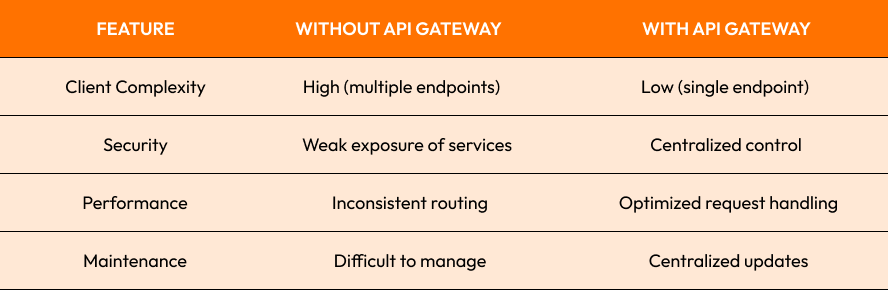
The API Gateway pattern solves the problem of clients needing to know details about every service without an API Gateway. That makes for a more complicated situation and adds the risk of loss of security.
A real-world example is Netflix. Billions of requests are extracted from their system every day. This also means that user requests for streaming or recommendations or even billing will be sent via the API Gateway without exposing internal systems.
Here’s a simple breakdown:
Strong opinion:
With this approach, especially for microservice oriented systems with more than five services without an API GateWay you are already creating technical debt.
How API Gateways Work in Microservices Architecture
Microservices Architecture involves breaking your application into smaller, independent services. Each service provides a single responsibility such as authentication,payments, user profile..
This increases scalability but adds complexity. This is where API Gateway comes in handy!
API Gateway Acts as a single entry point rather than exposing all microservices directly.
Here’s how it works:
- Client sends a request
- API Gateway receives the request
- It identifies the correct microservice
- It forwards the request
- It passes it on, aggregates and returns the response
Having this structure makes communication between members easier and incurs less work.
Centralized logic is a huge advantage. This means that instead of repeating authentication or logging in each microservice, the api gateway does it only one time.
For massive systems like Amazon or Uber, this architecture not only handles but smoothly serves requests in the millions every second.
One of the main advantages of microservices architecture is ease of scalability. The API Gateway handles traffic distribution, so that services can scale independently.
Strong opinion:
Microservices without an API Gateway are highways with no traffic control: fast, yes; uncontrolled, absolutely.
Difference between API Gateway and Load Balancer
You might come across people that confuse an API Gateway with a Load Balancer, but they are quite different.
Load Balancer is used to Balance the incoming traffic on multiple servers so that no individual server gets Overloaded. It only is concerned with distributing traffic.
An API Gateway is a lot more intelligent than that! That carries not just routing traffic but also processing, transforming and securing it.
Here’s a clear comparison:
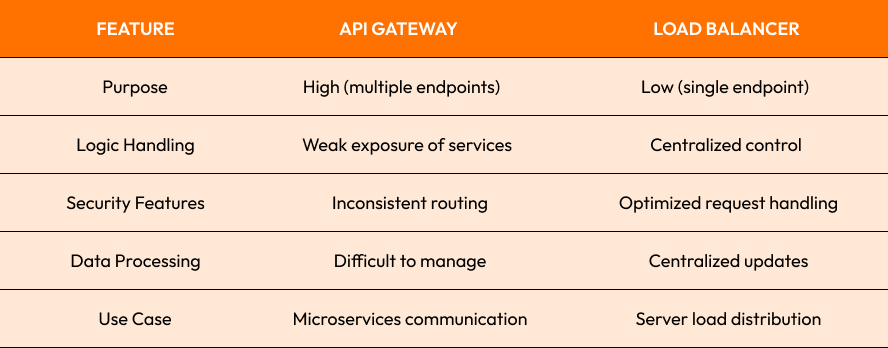
Think of a Load Balancer as a traffic police flowing cars evenly across the lanes. An API Gateway is essentially a smart hub which routes the requests as per need and directs them to proper channels.
However, both are often combined in modern systems. The Load Balancer distributes at the server level, while the API Gateway manages application level logic.
Strong opinion:
Mixing these two components leads to systems that are poorly designed and don’t scale well.
Performance Optimization and Caching in API Gateways
Performance is one of the key functions of an API Gateway. Even the best backend systems can slow down under traffic, if not properly optimised.
And this is where performance optimization techniques come in.
API Gateways improve performance through:
- Caching responses
- Reducing redundant requests
- Compressing data
- Load balancing traffic
- Request batching
Caching is especially powerful. Rather than resending multiple requests to backend services, the API Gateway can cache responses and return them when needed.
As an example where many users ask for product data, the API Gateway can directly serve cached responses instead of going to the database every time.
In fact, a case study of one of the leading e-commerce platforms observed that leveraging API Gateway Caching reduced 35%+ backend load and resulted in extremely faster response time.
Request aggregation: Another performance optimization technique The gateway reduces multiple calls from the client to a single request.
This enhances user experience and decreases latency.
Strong opinion:
Performance problems are commonly attributed to backend systems; but in many cases that conclusion is a red herring, often the actual bottleneck lies at a badly optimized API layer.

Request Routing and Traffic Management Strategies
Intelligent request routing and Traffic Management is the one of the most useful capability to have in an API Gateway
The API gateway does not just forward requests: instead, it decides based on:
- You are given data until October 2023
- The amount of traffic each service gets
- Throttle or Block requests reviewed
This is especially crucial in large scale systems where traffic spikes can happen at any time.
Common traffic management strategies include:
- Rate limiting
- Circuit breaking
- Canary deployments
- Blue-green deployments
- Geo-based routing
This can happen in bursts, such as when launching a product. The API Gateway is responsible for traffic control, so that the backend services are not overwhelmed.
Spotify is a real-world example; a leading music streaming application with millions of users around the world, staying online 24*7 using advanced routing strategies.
Such level of control is a must in modern-day web application architecture, where user retention issues arise whenever the application does not remain available or responsive.
Strong opinion:
Controlled failure is indeed what scaling an application comes down to; it all too easily breaks without the right traffic management installed.
Final Thoughts
The API Gateway has been a fundamental part of modern digital systems. Nord Stream makes digital security possible as applications transition to increasingly distributed microservices architecture; the need for centralized control, optimization and security is unavoidable.
API Gateways abstract away the difference from route Dispatching to performance tuning, caching and Traffic Management.
Key Challenges:
- Misconfigured routing rules
- Over-reliance on the gateway layer
- Poor caching strategies
- Lack of monitoring
Best Practices:
- Keep gateway logic lightweight
- Implement strong caching strategies
- Monitor traffic patterns continuously
- Merge with Load Balancer Where necessary
- Secure all API endpoints properly
Strong opinion:
Companies that brush off API architecture basics end up running into scaling walls they cannot recover from.

Ready to Build Scalable Web Systems?
If you are building modern applications and want scalable, secure and high-performance architecture, the API layer is where it all begins.
At Crescentic Digital, we design and implement robust API systems that support modern Web development needs from microservices to enterprise-scale platforms.
Go to our Contact Page and let us create for you, together, a faster, smarter scalable backend.
Start Your Expert Consultation
Please write your name and contact information below. We will respond as soon as possible.